Research steps
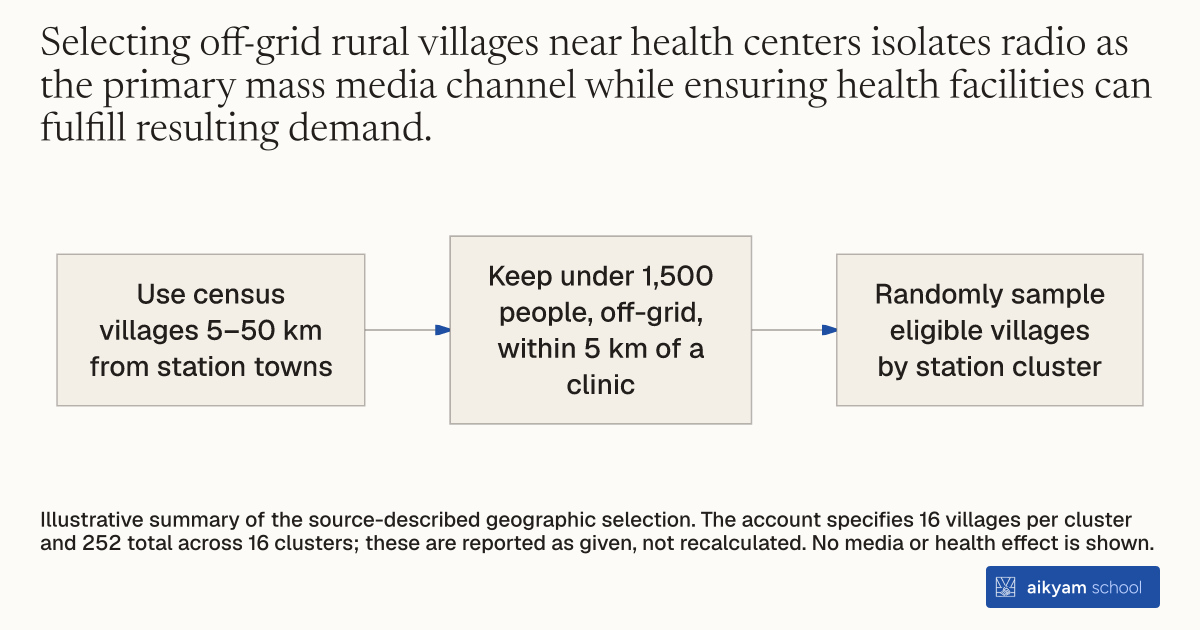
Select off-grid villages near health centres
- Use census villages 5–50 km from station towns
- Keep under 1,500 people, off-grid, within 5 km of a clinic
- Randomly sample eligible villages by station cluster
Illustrative summary of the source-described geographic selection. The account specifies 16 villages per cluster and 252 total across 16 clusters; these are reported as given, not recalculated. No media or health effect is shown.
See source →How
When to use
In low-income rural regions, researchers and evaluators need to select study communities to test a radio behavior change intervention. Standard rural villages often have mixed access to television or face severe contraceptive supply shortages at local clinics. Filtering candidate villages by population, distance to health facilities, grid connectivity, and broadcast distance ensures media isolation and adequate supply access.
Filter candidate villages using geographic, demographic, and infrastructure criteria to isolate radio exposure and eliminate health service supply bottlenecks.
- Identify all rural villages located between 5 and 50 kilometers from participating local radio station transmission towns.
- Select villages with fewer than 1,500 inhabitants using official national census data.
- Exclude all villages connected to the electrical grid to minimize television access and ensure high reliance on radio broadcasting.
- Retain only villages situated within 5 kilometers of an operational health center so contraceptive supply availability is not a constraint.
- Randomly sample 16 eligible villages per radio station cluster to establish the project sampling frame.
Why it works
This controls for supply-side bottlenecks and television-driven norm shifts.
Example
In Burkina Faso, researchers selected 252 villages across 16 radio station clusters to evaluate a radio behavior change campaign. Every selected village had fewer than 1,500 residents, lacked electricity grid connection, sat 5 to 50 kilometers from the radio station town, and lay within 5 kilometers of a health center. This sampling frame represented 1.4 million rural residents across Burkina Faso.
About the study
Participants
252 villages across 16 radio station broadcast clusters, representing 1.4 million inhabitants in rural Burkina Faso.
Study Design
Geographic and demographic filtering of census villages based on population size, radio distance, grid status, and clinic distance.
Results
Selecting 252 villages meeting these criteria produced a representative study population of 1.4 million people with baseline modern contraceptive prevalence of 23 percent.