Research procedure
Build the household sampling list
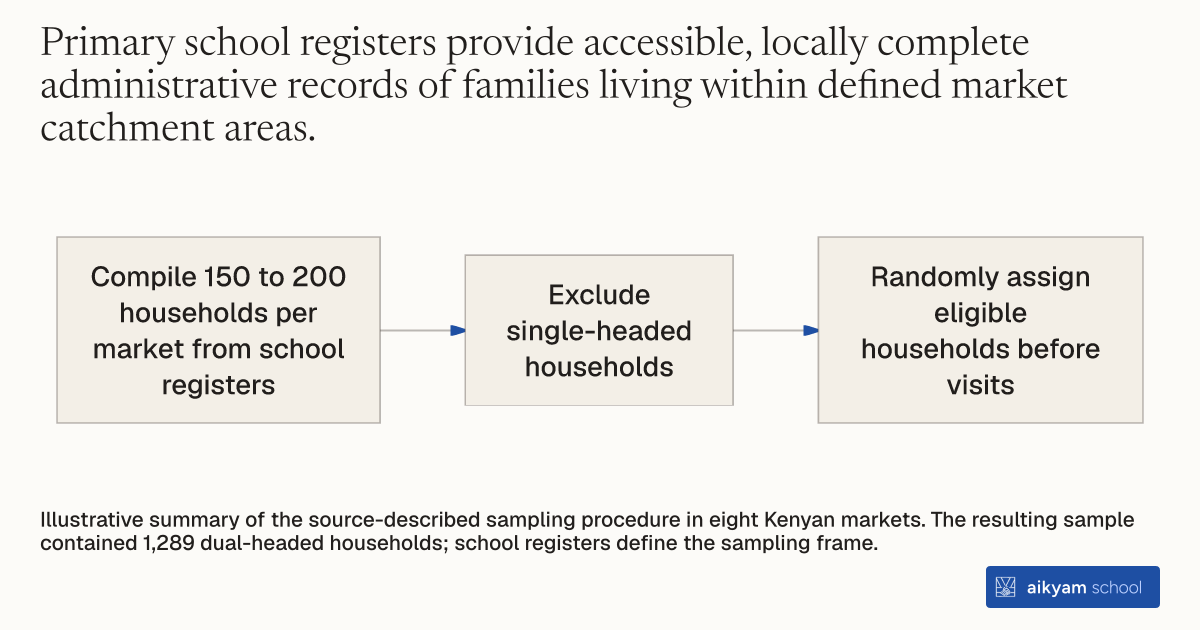
- Compile 150 to 200 households per market from school registers
- Exclude single-headed households
- Randomly assign eligible households before visits
Illustrative summary of the source-described sampling procedure in eight Kenyan markets. The resulting sample contained 1,289 dual-headed households; school registers define the sampling frame.
See source →How
When to use
Rural field interventions often lack formal census lists or household registries to sample target populations for health programs. Compiling sampling frames from primary school registers provides a structured way to reach households in rural market areas. This method targets research teams and community planners seeking a defined sampling frame for household health interventions.
Construct a household sampling frame by compiling student rosters from primary schools in target rural market areas and applying screening criteria.
- Identify primary schools located within designated rural market catchment areas.
- Obtain official student enrollment registers from each primary school to identify local families.
- Extract household details from school registers until compiling a list of 150 to 200 households per market area.
- Screen the compiled list to exclude single-headed households to focus on target decision-making structures.
- Randomly assign eligible dual-headed households from the compiled frame to assigned study treatment groups in the office prior to field visits.
Why it works
Using school records creates a reliable population list for household sampling when official municipal censuses are unavailable.
Example
Field researchers in Western Kenya compiled lists of 150 to 200 households from primary school registers across eight rural market areas, excluding single-headed households before randomly assigning remaining families to experimental health treatments.
About the study
Participants
1,289 dual-headed rural households sampled from school registers across eight market areas in Western Kenya, with an average household size of 7.43 members.
Study Design
Households sampled from primary school rosters across eight rural markets were screened to remove single-headed households and then randomly assigned in office to subsidy levels, marketing messages, commitment prompts, and gender targeting treatments.
Results
Sampling yielded a final study sample of 1,289 households across eight markets; baseline balance tests confirmed that randomized experimental price assignments were balanced across household size (p=0.69), assets (p=0.36), and baseline net ownership (p=0.40).