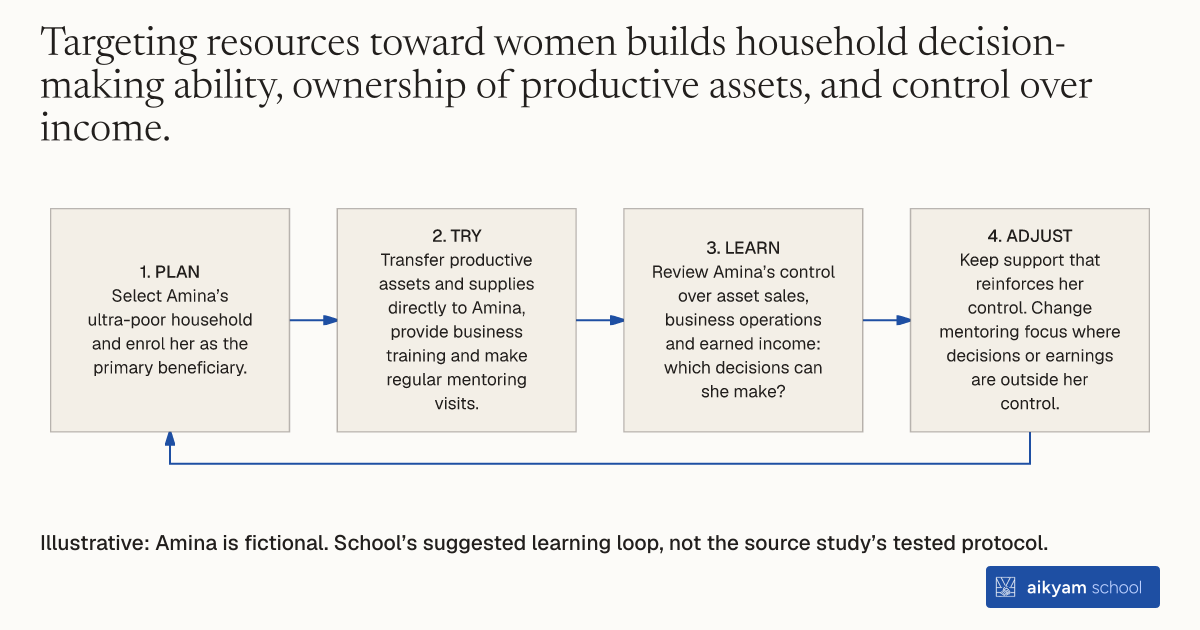
Try, learn and adjust
Check women retain control of resources and earnings
- Plan: Select Amina’s ultra-poor household and enrol her as the primary beneficiary.
- Try: Transfer productive assets and supplies directly to Amina, provide business training and make regular mentoring visits.
- Learn: Review Amina’s control over asset sales, business operations and earned income: which decisions can she make?
- Adjust: Keep support that reinforces her control. Change mentoring focus where decisions or earnings are outside her control.
Illustrative: Amina is fictional. School’s suggested learning loop, not the source study’s tested protocol.
See source →School’s suggested, untested loop. Observe resource receipt and control over assets, operations and income; do not assume ownership alone establishes empowerment.
How
When to use
Extreme poverty constraints often disproportionately affect women in low-income households. Traditional programs that deliver resources to male heads can leave women without economic agency or decision-making power. Directing productive assets and financial resources directly to female beneficiaries strengthens women's intrahousehold welfare and gender equity.
Direct productive assets, training, and financial resources explicitly to female household members to build female enterprise ownership.
- Program managers select ultra-poor households and enroll female members as primary beneficiaries.
- Implementation teams transfer productive assets and business supplies directly into female recipients' hands.
- Technical staff conduct business training designed specifically for female participants.
- Mentors conduct regular visits to reinforce women's autonomy over asset sales and business operations.
- Field staff support female participants in maintaining control over generated income earnings.
Why it works
This structural shift improves women's intrahousehold welfare, gender equity, and overall economic engagement.
Example
In Nepal, female beneficiaries were 24 percentage points more likely to control decisions regarding livestock sales and 14 percentage points more likely to control income earned from livestock.