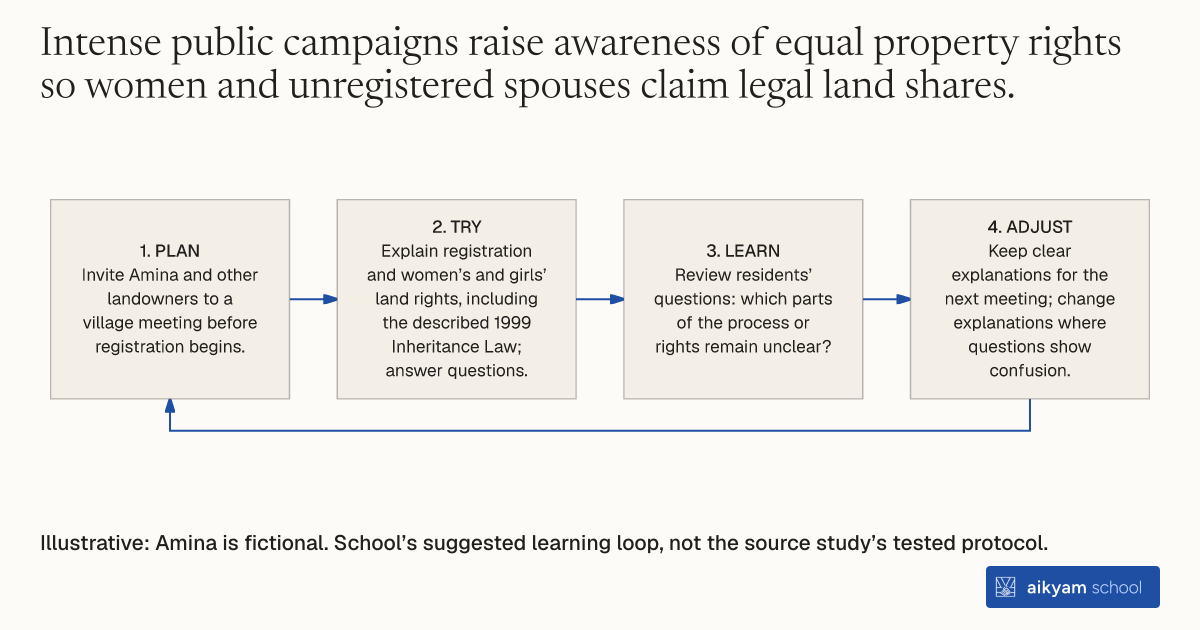
Try, learn and adjust
Check land-rights meeting questions
- Plan: Invite Amina and other landowners to a village meeting before registration begins.
- Try: Explain registration and women’s and girls’ land rights, including the described 1999 Inheritance Law; answer questions.
- Learn: Review residents’ questions: which parts of the process or rights remain unclear?
- Adjust: Keep clear explanations for the next meeting; change explanations where questions show confusion.
Illustrative: Amina is fictional. School’s suggested learning loop, not the source study’s tested protocol.
See source →School’s suggested learning loop: Observe attendance and questions before adjudication. This loop does not establish changes in land ownership.
How
When to use
Rural communities often maintain customary biases against female property ownership despite legal reforms. Local officials run community meetings to inform landowners about women's legal rights before registering property. This process helps rural women and households gain recognized land ownership.
Organize public sensitization meetings in rural cells prior to land adjudication to educate communities on women's legal land rights.
- Local government officers convene landowners in each village cell before land registration begins.
- Program staff explain the regularization process and discuss the advantages of registering parcels.
- Meeting facilitators place special emphasis on female and girls' land rights and the 1999 Inheritance Law.
- Program representatives answer resident questions to build community trust and transparency.
Example
The Government of Rwanda held sensitization meetings in village cells before starting land regularization. Over 90 percent of sampled landowners attended, including 86 percent of female-headed households and 68 percent of women in male-headed households.
About the study
Participants
3,600 households in 300 villages across 100 sectors in rural Rwanda.
Study Design
Cluster-randomized evaluation comparing 50 early-implementation sectors to 50 late-implementation sectors using difference-in-differences analysis on household survey data.
Results
Female registration rights on married couple parcels rose from 33 percent at baseline to 94 percent following implementation, and non-legally married women also gained significant land claims.