Try, learn and adjust
Check whether video advice reaches women farmers
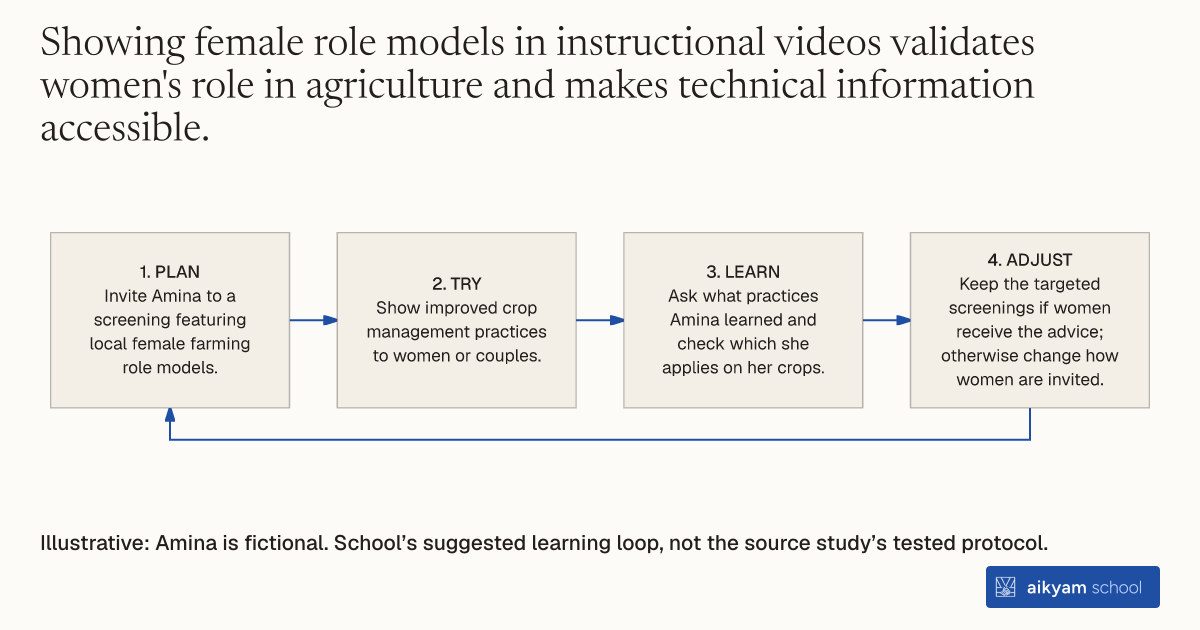
- Plan: Invite Amina to a screening featuring local female farming role models.
- Try: Show improved crop management practices to women or couples.
- Learn: Ask what practices Amina learned and check which she applies on her crops.
- Adjust: Keep the targeted screenings if women receive the advice; otherwise change how women are invited.
Illustrative: Amina is fictional. School’s suggested learning loop, not the source study’s tested protocol.
See source →Observe women’s knowledge, practice adoption and participation in farming decisions. School suggests this learning loop; it was not tested by the source.
How
When to use
Traditional extension approaches often marginalize women farmers, leaving them with limited access to agricultural advice and lower decision-making power. Delivering video-based advisory content featuring female role models helps bridge knowledge gaps for women smallholders. This method helps agricultural extension programs engage female farmers and enhance their role in household agricultural management.
Produce and feature video extension modules showcasing local female role models to deliver agricultural advice to women smallholders.
- Extension managers design video training modules featuring local female farming role models demonstrating improved crop management practices.
- Field agents schedule screening sessions for female farmers within rural agricultural communities.
- Extension workers deliver video screenings targeted specifically to female household members or couples.
- Female farmers observe effective management practices and decision-making demonstrated by local role models on screen.
- Female farmers apply the demonstrated techniques on their crops and increase their active participation in household farming decisions.
Why it works
Targeted delivery to women overcomes exclusion from traditional channels and boosts female agricultural decision-making power.
Example
In Uganda, agricultural extension researchers tested video-mediated extension targeting female household members with advisory content. Delivering information to women improved their knowledge and adoption of recommended practices by 13 percentage points relative to male-only targeting, while increasing women's agricultural decision-making power.
About the study
Participants
Smallholder maize-farming households in rural Uganda.
Study Design
Randomized controlled trial evaluating video-based extension messaging delivered to male members, female members, or couples, featuring local role models.
Results
Delivering video extension to women increased knowledge and adoption of recommended maize practices by 13 percentage points relative to male-only delivery, and targeting women individually significantly boosted female agricultural decision-making power.