Research steps
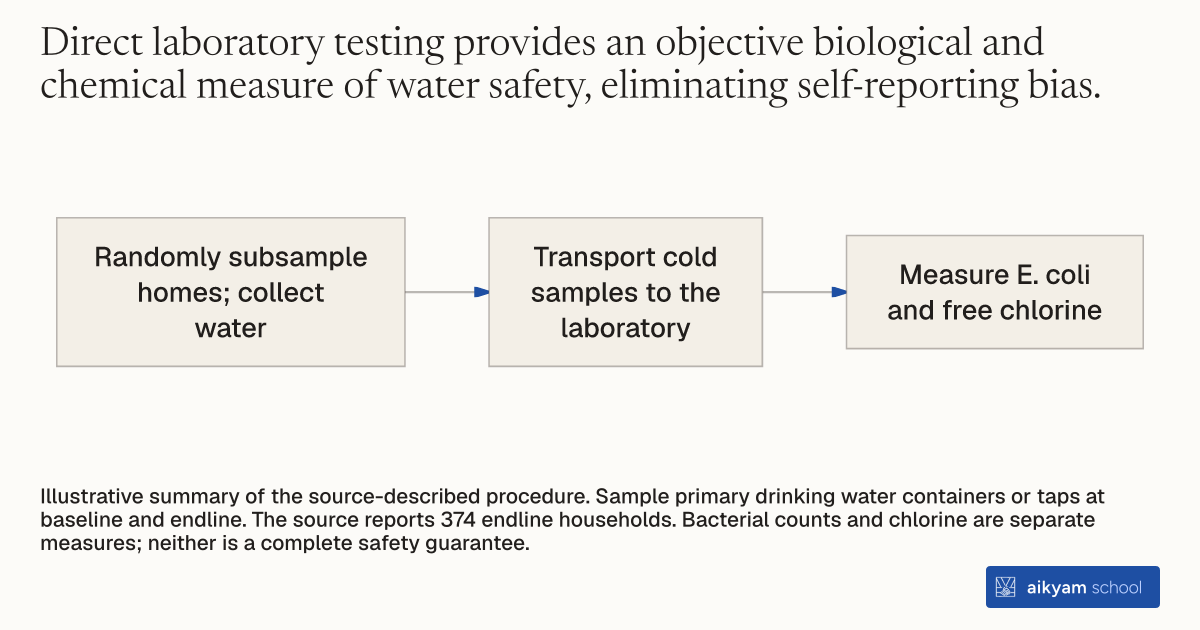
Test household drinking water
- Randomly subsample homes; collect water
- Transport cold samples to the laboratory
- Measure E. coli and free chlorine
Illustrative summary of the source-described procedure. Sample primary drinking water containers or taps at baseline and endline. The source reports 374 endline households. Bacterial counts and chlorine are separate measures; neither is a complete safety guarantee.
See source →How
When to use
Water infrastructure evaluations require verifying whether target households receive biologically safe drinking water. This method measures fecal coliform contamination and chemical disinfectant levels in household water samples. It determines if in-home connections improve water purity compared to public taps or neighbor sharing.
Test drinking water quality by collecting samples from participating households for laboratory biological and chemical analysis.
- Select a random subsample of study households during baseline and endline survey rounds.
- Collect water samples directly from primary drinking water storage containers or taps inside the home.
- Transport samples in cold storage to a laboratory for immediate testing.
- Measure the presence and precise colony count of fecal coliform bacteria E. coli in each sample.
- Measure the level of free chlorine residual in each sample to assess disinfectant retention.
Why it works
Comparing point-of-use samples reveals whether contamination occurs at the supply source, during transit, or during household storage.
Example
In Tangiers, Morocco, researchers tested drinking water samples from 374 households at endline. Testing revealed no significant difference in E. coli counts between connected and unconnected homes (10.43 coliforms in control), though connected homes were 15 percentage points more likely to have detectable chlorine (increasing from a 43 percent baseline).
About the study
Participants
Random subsample of 374 households across treatment and control groups in Tangiers, Morocco.
Study Design
Randomized subsample collection of household drinking water, followed by laboratory assays for E. coli coliform counts and free chlorine detection.
Results
In-home connections increased chlorine detection by 15 percentage points (or 0.23 to 0.27 in IV estimation) but produced no significant reduction in E. coli count (mean of 10.43 in control group).