Research steps
Test caregiver fingertip contamination
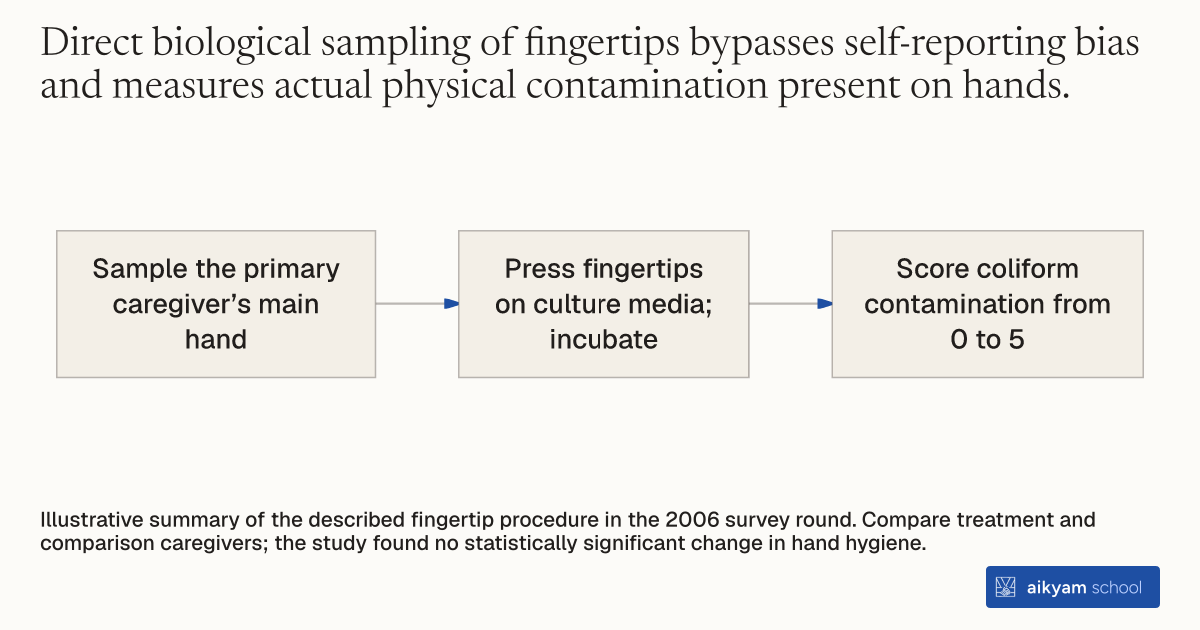
- Sample the primary caregiver’s main hand
- Press fingertips on culture media; incubate
- Score coliform contamination from 0 to 5
Illustrative summary of the described fingertip procedure in the 2006 survey round. Compare treatment and comparison caregivers; the study found no statistically significant change in hand hygiene.
See source →How
When to use
Self-reported handwashing and hygiene practices are frequently subject to social desirability bias during health evaluation surveys. Program evaluators need an objective, biological measure of personal hygiene to assess whether clean water projects alter hygiene practices. Direct microbial testing of a respondent's dominant hand provides a quantitative hygiene indicator.
Measure microbial fecal contamination on a respondent's dominant hand using standardized fingertip testing protocols.
- Survey enumerators visit household compounds during scheduled survey rounds.
- Enumerators identify the mother or primary child caregiver as the target survey respondent.
- Enumerators instruct the respondent to press the fingertips of their main hand onto nutrient agar or culture media.
- Laboratory staff incubate the sample to grow indicator bacteria.
- Laboratory staff score bacterial contamination levels on a discrete 0 to 5 scale based on coliform colony counts.
Why it works
Measuring indicator bacteria quantifies real-time hand hygiene and hygiene behavior changes without relying on subjective survey responses.
Example
In Busia and Butere-Mumias districts of western Kenya, survey staff collected fingertip contamination samples from primary child caregivers across 1,354 households during the 2006 survey round, scoring main hand contamination on a 0 to 5 scale.
About the study
Participants
1,354 households across 184 spring communities in Busia and Butere-Mumias districts, Kenya.
Study Design
Cross-sectional comparison between treatment and control group primary caregivers during the third survey round (2006), scoring main hand fecal contamination on a 0 to 5 scale.
Results
Spring protection produced no statistically significant change in caregiver hand hygiene, with fingertip fecal contamination levels remaining statistically indistinguishable between treatment and comparison groups.