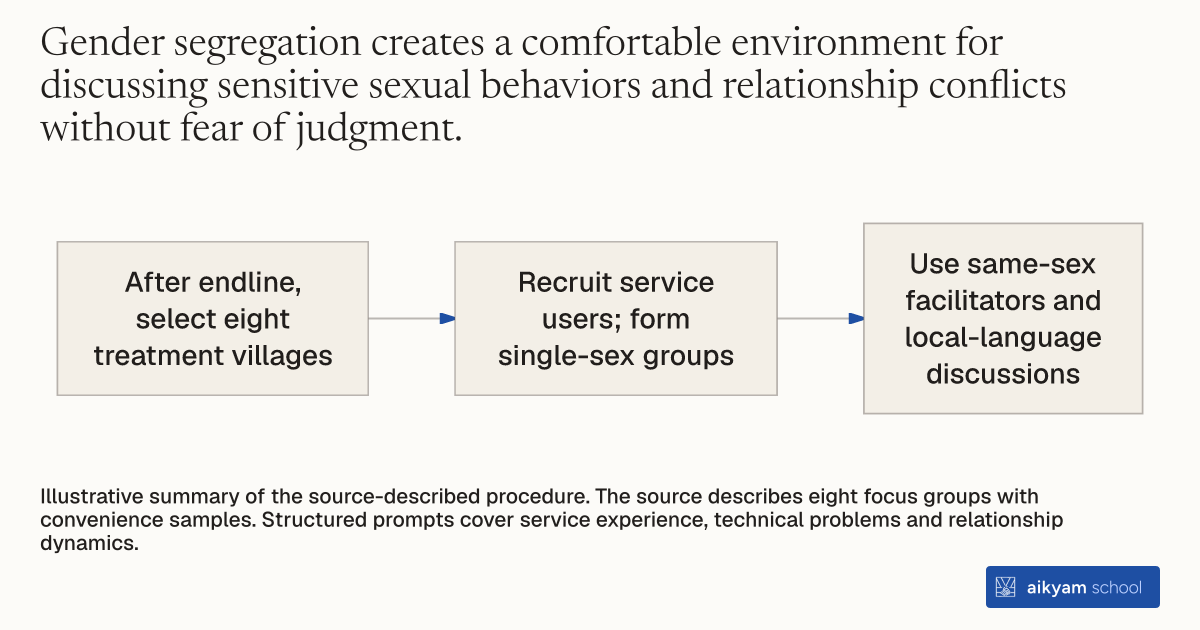
Research steps
Discuss service use in single-sex groups
- After endline, select eight treatment villages
- Recruit service users; form single-sex groups
- Use same-sex facilitators and local-language discussions
Illustrative summary of the source-described procedure. The source describes eight focus groups with convenience samples. Structured prompts cover service experience, technical problems and relationship dynamics.
See source →How
When to use
Quantitative survey evaluations often reveal unexpected findings without explaining the underlying social mechanisms. Measuring sensitive topics like sexual health requires open dialogue to understand user experiences and community norms. This method conducts single-sex group interviews to explore user perceptions and explain quantitative trial results.
Conduct qualitative focus group discussions separated strictly by gender following quantitative endline data collection.
- Evaluators randomly select eight treatment villages across four study districts for qualitative evaluation.
- Field staff recruit a convenience sample of service users within each selected village community.
- Facilitators separate male and female participants into single-sex discussion groups led by an enumerator of their own sex.
- Same-sex enumerators guide open discussions in the local language using structured interview protocols.
- Discussion leaders probe user experiences, technical challenges, perceived knowledge shifts, and relationship power dynamics.
Why it works
Open qualitative dialogue surfaces social mechanisms, partner power imbalances, and technical barriers that quantitative surveys cannot capture.
Example
Researchers conducted eight single-sex focus group discussions across eight treatment villages in central Uganda following endline survey collection to investigate why the 6001 SMS service increased promiscuity.
About the study
Participants
Service users across eight focus group discussions in eight randomly selected treatment villages across Masaka, Mpigi, Mityana, and Mubende districts in central Uganda.
Study Design
Qualitative evaluation using single-sex focus group discussions conducted by same-sex enumerators in the local language following quantitative endline data collection.
Results
Qualitative focus groups identified key mechanisms behind program non-effects and increased male promiscuity, including lack of reminder messages, translation errors, transport constraints for medical care, and relationship power dynamics where women refusing sex led men to seek external partners.