Research procedure
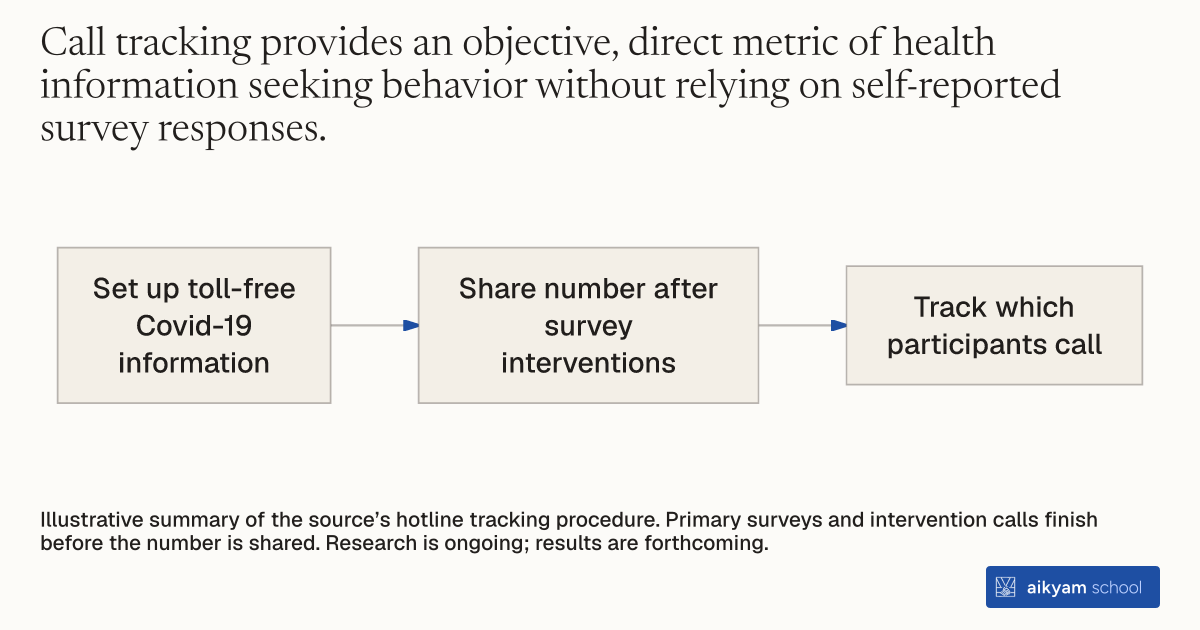
Track demand for health information
- Set up toll-free Covid-19 information
- Share number after survey interventions
- Track which participants call
Illustrative summary of the source’s hotline tracking procedure. Primary surveys and intervention calls finish before the number is shared. Research is ongoing; results are forthcoming.
See source →How
When to use
Measuring health behavior changes through surveys alone can be subject to reporting bias. Program evaluators need objective behavioral indicators to evaluate demand for protective health guidance. Track toll-free phone calls to measure demand for Covid-19 protection information among vulnerable adults.
Track utilization of a toll-free hotline to measure health information demand among study participants after health interventions.
- Set up a toll-free phone number offering information on protecting against Covid-19.
- Complete all primary health survey interviews and informational intervention calls with participants.
- Share the toll-free phone number with participants at the conclusion of the survey interventions.
- Record and track which participants call the toll-free number to measure individual demand for health information.
Example
In Coimbatore, Tamil Nadu, India, researchers shared a toll-free health information number with 3,680 diabetic and hypertensive participants aged 40 to 70 years old and tracked call volume to measure demand for protective information.
About the study
Participants
3,680 diabetic and hypertensive individuals aged 40 to 70 years old in Coimbatore, Tamil Nadu, India.
Study Design
Toll-free number utilization tracking following a randomized controlled trial providing information interventions over phone calls.
Results
Research ongoing; results forthcoming.