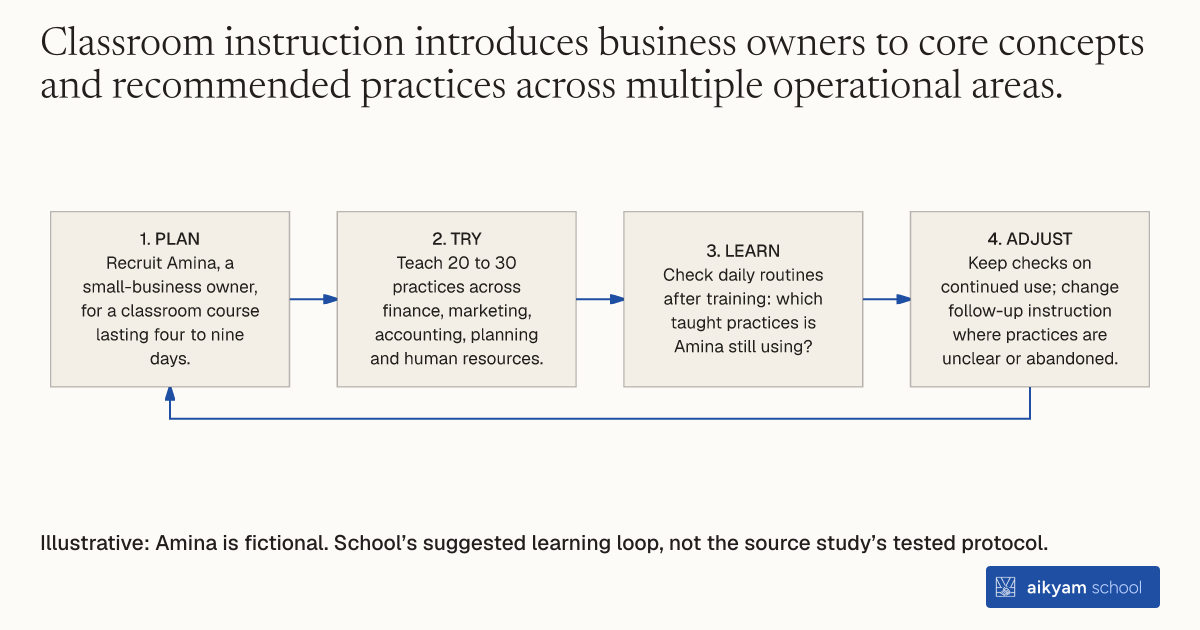
Try, learn and adjust
Check broad business lessons become routines
- Plan: Recruit Amina, a small-business owner, for a classroom course lasting four to nine days.
- Try: Teach 20 to 30 practices across finance, marketing, accounting, planning and human resources.
- Learn: Check daily routines after training: which taught practices is Amina still using?
- Adjust: Keep checks on continued use; change follow-up instruction where practices are unclear or abandoned.
Illustrative: Amina is fictional. School’s suggested learning loop, not the source study’s tested protocol.
See source →School’s suggested, untested learning loop. Observe business practice use over time; the review reports modest average gains and examples of fading adoption.
How
When to use
Microentrepreneurs in low-income countries often lack foundational business practices to manage and expand their small enterprises. Standardized classroom programs provide entry-level training across multiple management disciplines for business owners with few or no employees. This method introduces essential accounting, marketing, and planning skills to poor households.
Deliver classroom-based group instruction on core business disciplines to potential and existing microentrepreneurs in structured workshops.
- Program administrators recruit potential and existing microentrepreneurs who operate small enterprises with few or no employees.
- Instructors assemble participants in classroom settings for multi-day courses lasting between four and nine days.
- Trainers deliver lectures combining modules on financial management, marketing, accounting, financial planning, and human resources.
- Participants cover twenty to thirty separate business practices taught across disciplines over a short timeframe.
- Microentrepreneurs return to their enterprises and implement the newly learned business practices in daily operations.
Why it works
This direct exposure helps entrepreneurs identify basic recordkeeping, marketing, and accounting routines to adopt in their firms.
Example
In Kenya, microentrepreneurs attended four two-hour training courses, leading 86 percent of attendees to keep formal records compared to non-trained peers, though practice adoption faded four months after the course.
About the study
Participants
Potential and existing microentrepreneurs in low- and middle-income countries, evaluated across 28 randomized studies representing 4 to 5 million microentrepreneurs trained annually.
Study Design
Review and meta-analysis of 28 randomized controlled trials measuring business practice uptake, sales, and profits over short- and long-run horizons.
Results
Traditional business skills training programs increased sales by 5.6 percent on average and profits by 12.1 percent on average; practice adoption increased short-term recordkeeping in Kenya by 19 percentage points before fading after 4 months, and tailors in Ghana raised management practice scores by 5.7 percentage points before reverting after 1 year, while Sri Lankan owners maintained practice use for 2 years without profit gains.