Try, learn and adjust
Check borrowers receive the stated repayment terms
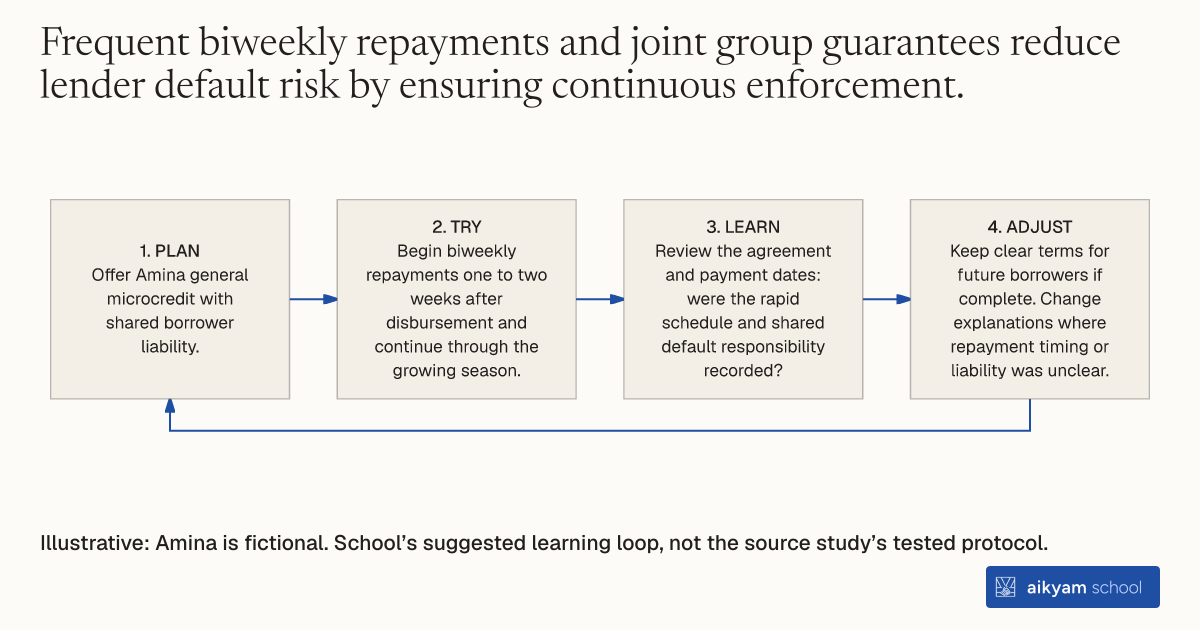
- Plan: Offer Amina general microcredit with shared borrower liability.
- Try: Begin biweekly repayments one to two weeks after disbursement and continue through the growing season.
- Learn: Review the agreement and payment dates: were the rapid schedule and shared default responsibility recorded?
- Adjust: Keep clear terms for future borrowers if complete. Change explanations where repayment timing or liability was unclear.
Illustrative: Amina is fictional. School’s suggested learning loop, not the source study’s tested protocol.
See source →School’s suggested, untested loop. Observe repayment timing and group liability. The source reports take-up of 13% to 33% across four trials, not assured farm gains.
How
When to use
Microfinance institutions provide general cash loans to smallholder farmers to invest in agricultural production or business assets. Traditional microcredit enforces rigid, immediate repayment schedules and shared group guarantees.
Disburse general microcredit loans requiring immediate, frequent repayments and shared borrower liability.
- Financial institutions disburse general microcredit cash loans to smallholder farmers at the start of the season.
- Lenders require borrowers to begin biweekly repayments starting one to two weeks after loan disbursement.
- Lenders enforce group liability mechanisms where neighboring borrowers share joint responsibility for loan defaults.
- Lenders collect biweekly repayment installments continuously throughout the crop growing cycle.
Example
In evaluations across Morocco, Ethiopia, Bangladesh, and Malawi, smallholder farmers were offered traditional microcredit requiring biweekly repayments starting one to two weeks after disbursement, resulting in take-up rates between 13 and 33 percent.
About the study
Participants
Smallholder farmers in Morocco, Ethiopia, Bangladesh, and Malawi.
Study Design
Four randomized controlled trials evaluating traditional microcredit take-up and agricultural investments under rapid repayment schedules.
Results
Take-up rates for traditional microcredit ranged from 13 to 33 percent among eligible farmers across the four study sites.