Research procedure
Score difficulty with daily activities
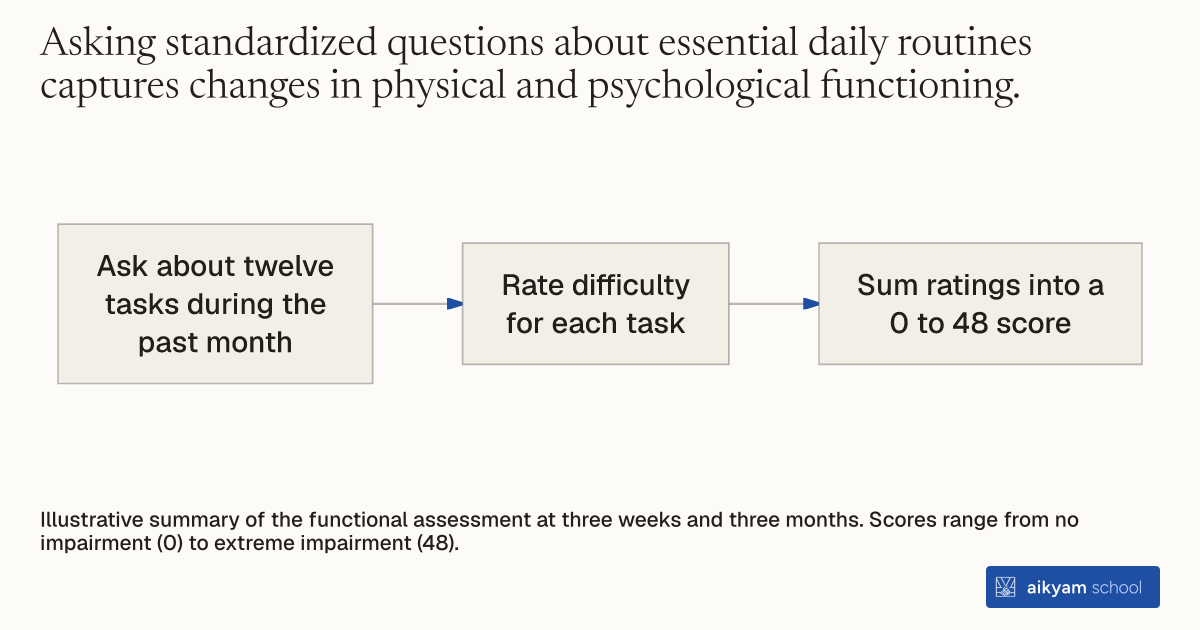
- Ask about twelve tasks during the past month
- Rate difficulty for each task
- Sum ratings into a 0 to 48 score
Illustrative summary of the functional assessment at three weeks and three months. Scores range from no impairment (0) to extreme impairment (48).
See source →How
When to use
Older adults living alone face physical and cognitive decline that hinders their daily routines. Program evaluators need a standardized tool to quantify participant functional impairment. Use this survey instrument to measure self-reported difficulty in executing everyday tasks.
Measure functional impairment among older adults by scoring self-reported difficulty across twelve daily activities.
- Surveyors visit or contact low-income older adult participants at follow-up periods.
- Surveyors ask participants to rate their level of difficulty performing twelve activities of daily living over the past month.
- Surveyors assign ratings for each of the twelve daily tasks on a standardized scale.
- Surveyors sum the responses into a composite score ranging from 0 (no functional impairment) to 48 (extreme functional impairment) points.
Why it works
Tracking composite ADL scores allows researchers to detect short-term and medium-term impacts of mental health and cash transfer interventions.
Example
Researchers evaluated 1,120 older adults living alone in Tamil Nadu, India, using the 12-item ADL survey at three weeks and three months post-treatment. At three weeks, cash transfer recipients experienced a 2.9-point score reduction in functional impairment relative to the comparison group.
About the study
Participants
1,120 low-income adults aged 55 or older living alone in Tamil Nadu, India (83 percent women, 77.1 percent widowed).
Study Design
Randomized controlled trial assessing self-reported difficulty across 12 daily tasks scored from 0 to 48 points at three weeks and three months follow-up across four trial arms.
Results
Unconditional cash transfers decreased functional impairment by 2.9 points relative to comparison at three weeks, with women showing a 4.1-point reduction, though neither CBT nor cash transfers showed sustained effects at three months.