Research design
Randomize parishes, then polling stations
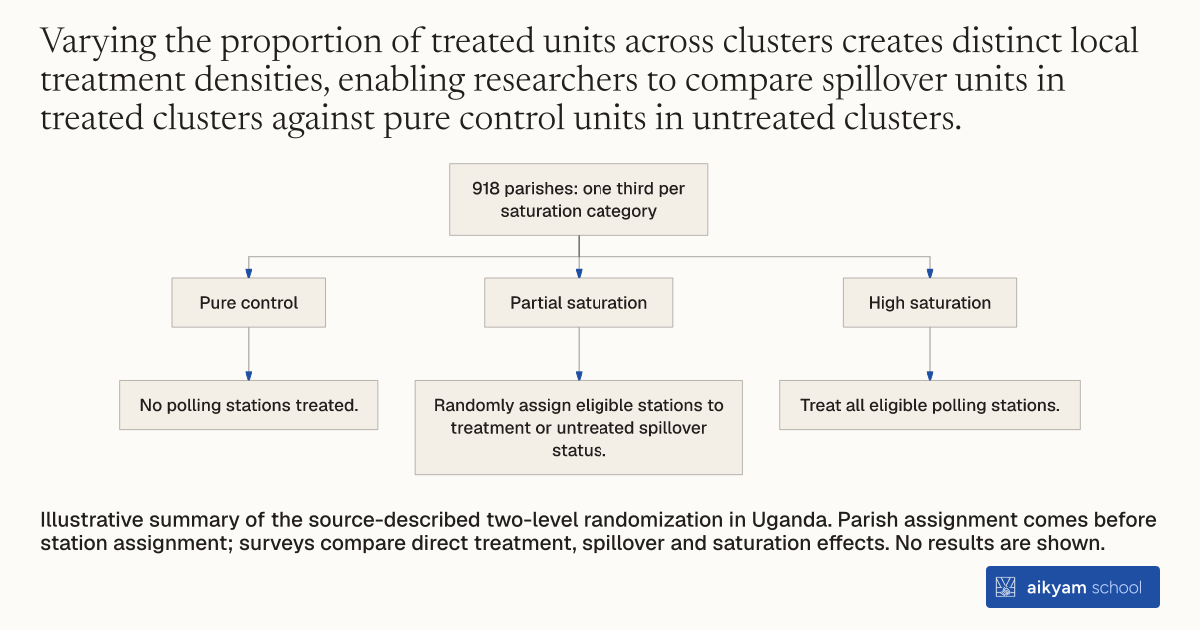
918 parishes: one third per saturation category
- Pure control
- No polling stations treated.
- Partial saturation
- Randomly assign eligible stations to treatment or untreated spillover status.
- High saturation
- Treat all eligible polling stations.
Illustrative summary of the source-described two-level randomization in Uganda. Parish assignment comes before station assignment; surveys compare direct treatment, spillover and saturation effects. No results are shown.
See source →How
When to use
When evaluating community-wide interventions, treatments delivered in one location often spill over to neighboring untreated areas, biasing standard experimental comparisons. Evaluators need a method to measure both direct treatment effects and spatial spillover effects while assessing how campaign saturation alters outcomes. Randomizing treatment at both cluster and subunit levels allows researchers to isolate direct effects, spillover impacts, and market-level saturation dynamics.
Execute a two-level randomized saturation design by randomizing higher-level clusters across saturation categories and then randomizing lower-level subunits within treated clusters.
- Define a sample of higher-level geographical or administrative clusters, such as parishes, and stratify them on baseline demographic and political characteristics.
- Randomly assign clusters into three groups: pure control with zero saturation, partial saturation, and high saturation.
- Identify eligible lower-level subunits, such as polling stations or villages, within each cluster based on local activist availability.
- Randomly assign eligible subunits in partial-saturation clusters to either direct treatment or untreated spillover status.
- Assign all eligible subunits in high-saturation clusters to direct treatment, and keep all subunits in control clusters untreated.
- Survey respondents across treated, spillover, and pure control subunits to estimate direct treatment effects, spatial spillovers, and saturation intensity effects.
Why it works
This structure isolates direct individual treatment effects from broader market-wide or community-wide spillover dynamics.
Example
Researchers evaluated an anti-vote-buying campaign in Uganda across 918 parishes and 1,603 eligible polling stations covering 1.2 million registered voters, assigning one-third of parishes to pure control, one-third to partial saturation, and one-third to high saturation.
About the study
Participants
28,454 registered voters surveyed across 918 parishes, 2,796 eligible villages, and 1,603 polling stations in 53 districts in Uganda.
Study Design
Two-level randomized saturation design assigning 918 parishes to pure control, partial saturation, or high saturation, and randomizing polling stations within partial-saturation parishes to measure treatment, spillover, and saturation effects.
Results
Identified a 1.3 percentage point increase in awareness of anti-vote-buying negative consequences in treated villages, a 0.09 standard deviation increase in challenger vote buying in fully saturated parishes, and a 0.18 standard deviation drop in incumbent vote share in fully saturated parishes.