Research survey
Collect baseline and endline tablet interviews
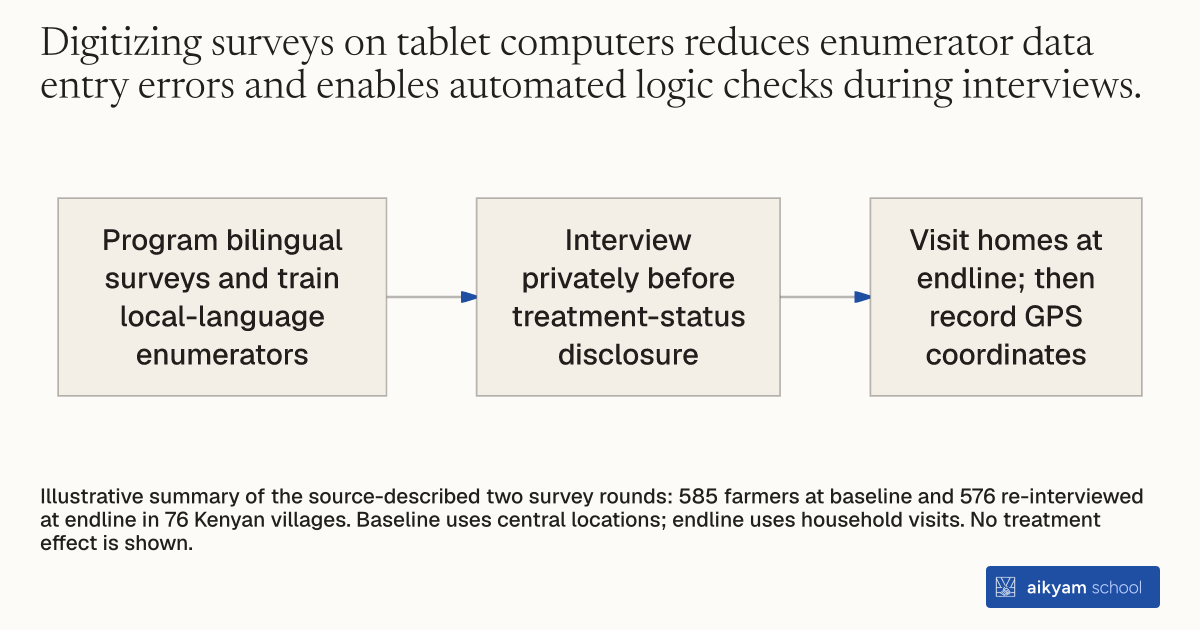
- Program bilingual surveys and train local-language enumerators
- Interview privately before treatment-status disclosure
- Visit homes at endline; then record GPS coordinates
Illustrative summary of the source-described two survey rounds: 585 farmers at baseline and 576 re-interviewed at endline in 76 Kenyan villages. Baseline uses central locations; endline uses household visits. No treatment effect is shown.
See source →How
When to use
Evaluating agricultural development programs in rural areas requires tracking subtle household behavior changes over time. Paper surveys in remote regions risk high data entry error rates, lost forms, and delayed analysis. This method collects high-frequency household survey data electronically across two survey rounds to measure baseline conditions and endline impacts.
Collect electronic household data across baseline and endline rounds using localized survey enumerators equipped with tablet computers.
- Program survey instruments in Swahili and English onto mobile tablet software, including conditional skips and logical consistency checks.
- Recruit trained enumerators fluent in Swahili, English, and local dialects to conduct computer-assisted personal interviews.
- Administer baseline surveys privately with farmers at central village locations before disclosing intervention treatment status.
- Conduct endline surveys through direct household visits using local guides and farmer coordinators to locate respondents.
- Record exact GPS coordinates on tablets at household locations following endline survey completion.
Why it works
Conducting baseline interviews before revealing treatment assignments eliminates experimenter demand effects and selective survey reporting.
Example
Enumerators collected tablet survey data from 585 smallholders in Migori County, Kenya at baseline in May-June 2018 and at endline following harvest. The two-round panel achieved high completion rates across 576 endline households, documenting a 15% increase in total crop output per acre among watchman-matched farms.
About the study
Participants
585 smallholders in 76 villages across Suna East, Suna West, and Uriri sub-counties in Migori County, Kenya (576 re-interviewed at endline).
Study Design
Two-round panel survey (central location baseline, household-visit endline with GPS capture) analyzed using differences-in-differences and ANCOVA specifications.
Results
Tablet surveying captured 1,153 total household-round observations, detecting a 39.4 percentage point drop in reported low farm security (p < 0.01) and a 32.5 percentage point reduction in actual crop theft (p < 0.01) with zero balance differences across 29 baseline covariates.