Try, learn and adjust
Check counselling continues after placement
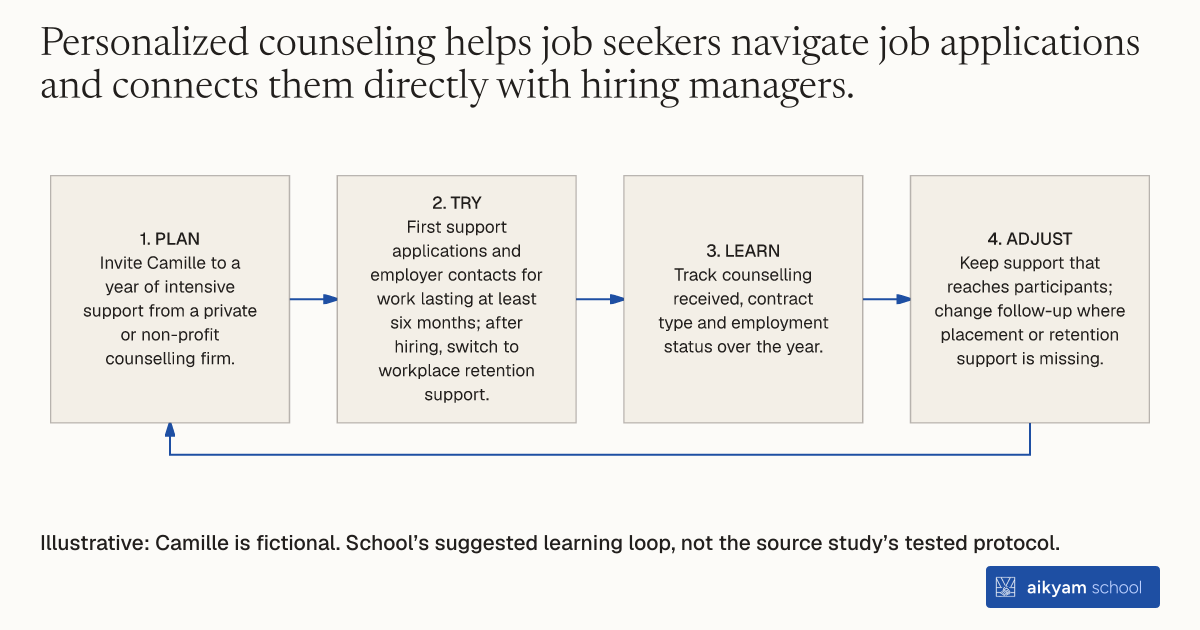
- Plan: Invite Camille to a year of intensive support from a private or non-profit counselling firm.
- Try: First support applications and employer contacts for work lasting at least six months; after hiring, switch to workplace retention support.
- Learn: Track counselling received, contract type and employment status over the year.
- Adjust: Keep support that reaches participants; change follow-up where placement or retention support is missing.
Illustrative: Camille is fictional. School’s suggested learning loop, not the source study’s tested protocol.
See source →Observe both counselling stages and employment. The example’s eight-month gains disappeared by twelve months. School suggests this learning loop; it was not tested by the source.
How
When to use
Young college graduates often struggle to transition from university into stable, long-term employment due to unfamiliarity with recruitment processes. A two-stage counseling program provides intensive, personalized guidance to help candidates secure initial long-term jobs and maintain employment once hired. This approach serves unemployed youth who hold higher education qualifications but lack extensive work experience.
Deliver a two-stage intensive career counseling program that guides unemployed graduates through job placement and workplace retention.
- Invite eligible job seekers to connect with private or non-profit counseling firms for a year of support.
- Conduct the first counseling stage focused on helping participants find employment contracts lasting at least six months.
- Prepare candidates for job applications and connect them directly with potential employers.
- Transition hired participants into the second stage focused on stabilizing them in their new workplace.
- Track participant employment status over a full year to encourage long-term retention.
Why it works
Following up after hiring helps participants address early workplace challenges and maintain job stability.
Example
In France between 2007 and 2010, researchers evaluated a government program offering a year of intensive counseling to nearly 30,000 young graduates across 235 communities. Candidates offered counseling were 2.5 percentage points more likely to find long-term jobs after eight months than untreated peers in the same areas, but gains vanished by twelve months.
About the study
Participants
Nearly 30,000 young, college-educated job seekers in their mid-twenties possessing at least a two-year degree and unemployed for at least six months across 235 communities in France.
Study Design
Randomized controlled trial comparing eligible job seekers assigned to receive intensive counseling from private agencies against comparison individuals using standard public employment services.
Results
Offering intensive counseling increased long-term employment by 2.5 percentage points after eight months compared to comparison job seekers in treated areas, but take-up was 35 percent and relative gains disappeared after twelve months.