Research procedure
Sample villages, then households
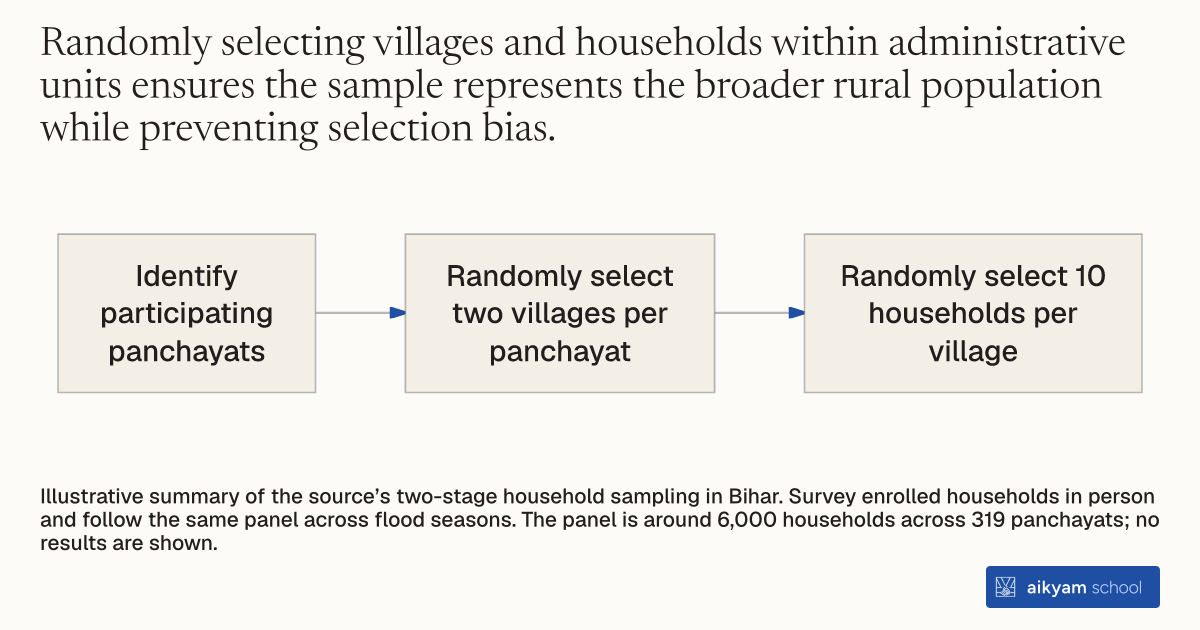
- Identify participating panchayats
- Randomly select two villages per panchayat
- Randomly select 10 households per village
Illustrative summary of the source’s two-stage household sampling in Bihar. Survey enrolled households in person and follow the same panel across flood seasons. The panel is around 6,000 households across 319 panchayats; no results are shown.
See source →How
When to use
Evaluating disaster intervention impacts requires representative household data across widely dispersed rural communities without selection bias. Multi-stage random panel sampling solves this by selecting geographic administrative units and individual households systematically before tracking them over time. This method serves development economists and impact evaluators measuring community-level program effectiveness.
Select a representative panel of rural households using a structured two-stage randomized sampling process across targeted administrative governments.
- Identify the full set of local rural government units participating in the evaluation sample.
- Randomly select two villages from each participating local government unit.
- Randomly select 10 households from each selected village.
- Conduct detailed in-person household surveys across the enrolled sample.
- Follow the enrolled panel of households over multiple flood seasons to assess program effectiveness over time.
Why it works
Following the same panel over multiple seasons allows researchers to assess long-run intervention effectiveness across variable climate conditions.
Example
Researchers enrolled a panel of around 6,000 households across 319 panchayats in Bihar, India by selecting two villages per panchayat and 10 households per village to evaluate flood early warning alerts.
About the study
Participants
Panel of around 6,000 rural households across 319 panchayats in 12 flood-prone districts in Bihar, India; survey evaluated 634 households across 119 panchayats.
Study Design
Two-stage randomized sampling selecting two villages per panchayat and 10 households per village, embedded within a randomized controlled trial comparing community volunteer warning dissemination against digital alerts alone.
Results
Survey of 634 households across 119 panchayats showed treatment households received 2.37 more alerts (a 290 percent increase), were 27 percent more likely to receive alerts, 46.5 percent more likely to receive warnings before floodwaters arrived, and 57 percent more likely to report receiving highly accurate alerts.