Research steps
Survey voters before and after election day
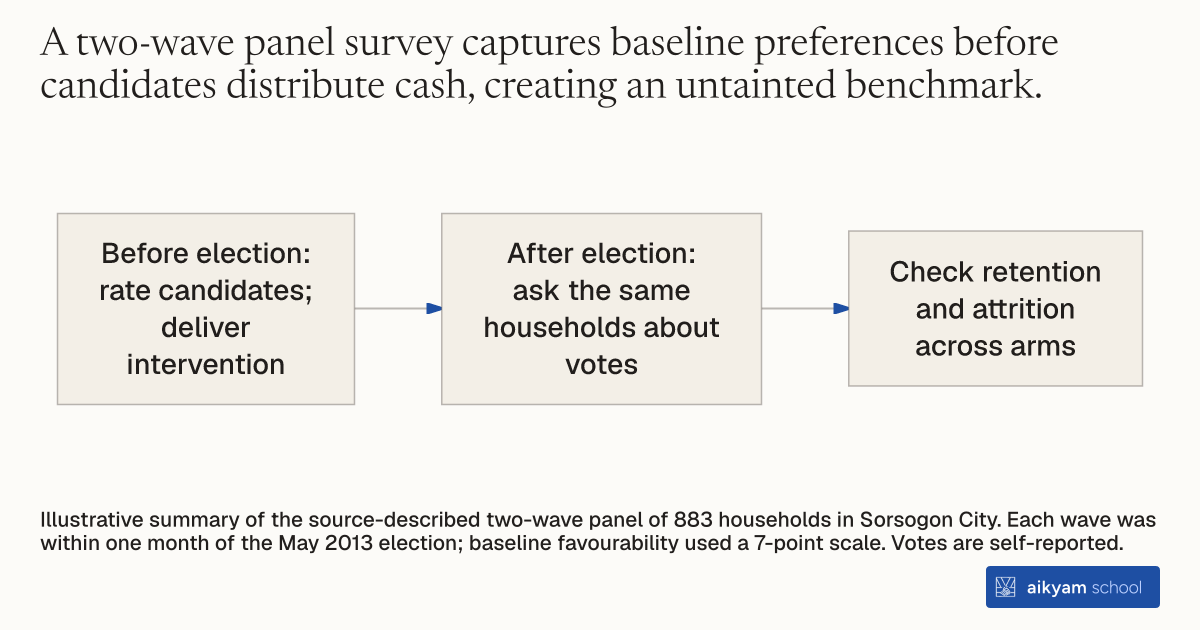
- Before election: rate candidates; deliver intervention
- After election: ask the same households about votes
- Check retention and attrition across arms
Illustrative summary of the source-described two-wave panel of 883 households in Sorsogon City. Each wave was within one month of the May 2013 election; baseline favourability used a 7-point scale. Votes are self-reported.
See source →How
When to use
Researching clientelism and voter behavior in secret-ballot elections requires tracking individual-level preference shifts across candidate campaign periods. This method applies to electoral studies in developing democracies where researchers need pre-election baseline preferences and post-election behavior.
Administer a structured two-wave household panel survey before and after an election to track preference changes and vote choices.
- Enumerators visit randomly selected households in targeted electoral districts during the month leading up to an election.
- Enumerators administer a baseline survey measuring candidate favorability ratings on a 7-point scale across all contested races.
- Enumerators deliver experimental intervention materials or civic education to household members at the close of the baseline visit.
- Enumerators return to the same households within one month following election day to conduct a second survey wave recording actual reported votes.
- Analysts calculate wave-to-wave retention rates and verify that attrition does not differ significantly across experimental arms.
Why it works
Returning post-election to measure reported votes enables direct within-subject comparisons while allowing researchers to test for differential attrition.
Example
In Sorsogon City, Philippines, researchers conducted baseline surveys with 883 households before the May 2013 elections and returned post-election, achieving a 95.9% re-interview retention rate across treatment arms.
About the study
Participants
883 household respondents in Sorsogon City, Philippines during the May 2013 municipal elections.
Study Design
Two-wave household panel survey (baseline 1 month pre-election, follow-up 1 month post-election) integrated into a randomized field experiment across 3 treatment arms.
Results
Achieved a 95.9% post-election re-interview retention rate with no statistically significant differences in attrition across treatment arms; baseline data captured 883 households across mayoral, vice-mayoral, and city council races.