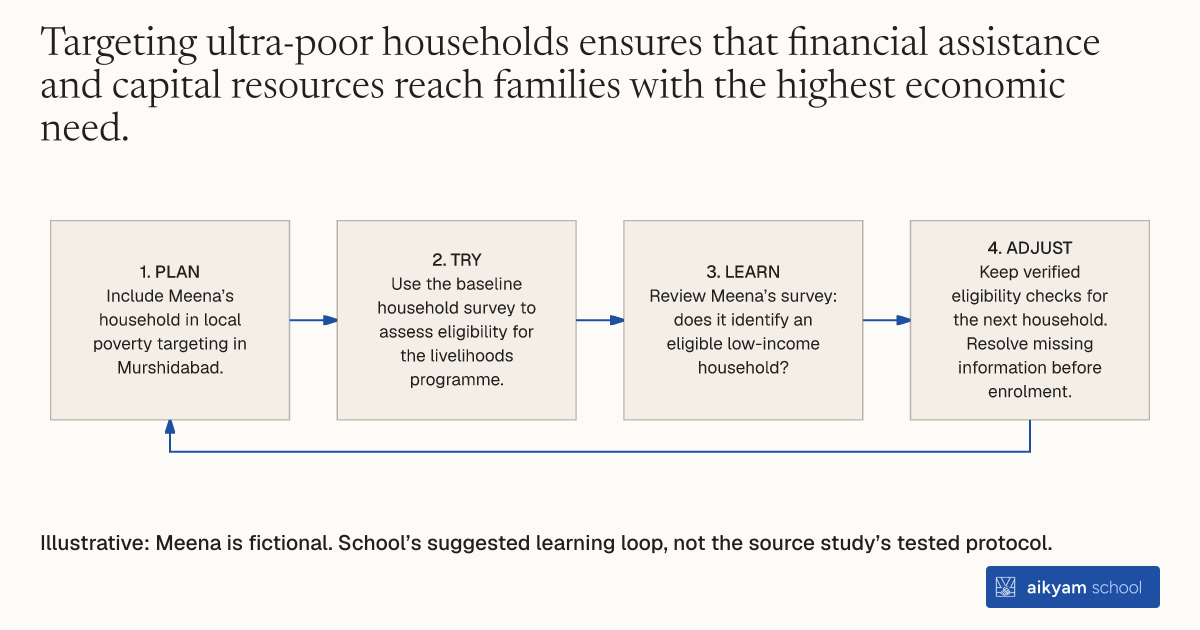
Try, learn and adjust
Check household eligibility before asset support
- Plan: Include Meena’s household in local poverty targeting in Murshidabad.
- Try: Use the baseline household survey to assess eligibility for the livelihoods programme.
- Learn: Review Meena’s survey: does it identify an eligible low-income household?
- Adjust: Keep verified eligibility checks for the next household. Resolve missing information before enrolment.
Illustrative: Meena is fictional. School’s suggested learning loop, not the source study’s tested protocol.
See source →School’s suggested, untested loop. Observe surveyed household eligibility; do not treat all evaluation households as asset recipients.
How
When to use
Ultra-poor households in rural areas live in extreme poverty and lack access to productive assets. Traditional development and microfinance initiatives often fail to reach these destitute families because they lack credit histories or financial collateral. This method serves non-governmental organizations and social policy makers aiming to assist hard-core poor households in developing regions.
Target destitute rural households through localized partner organizations to deliver intensive poverty alleviation programs.
- Non-governmental organization staff identify poverty-stricken rural regions in Murshidabad, West Bengal, India.
- Field workers conduct baseline surveys in May 2007 to identify eligible low-income households.
- Program managers select 817 vulnerable households to participate in the livelihoods evaluation.
- Local staff enroll selected families into the multi-faceted Graduation Approach program.
Why it works
Direct identification allows programs to engage destitute populations who are normally excluded from standard development initiatives.
Example
Bandhan targeted 817 low-income households in Murshidabad, West Bengal, India, assigning 429 households to receive productive assets and 388 households to a comparison group.
About the study
Participants
817 low-income households in Murshidabad, West Bengal, India.
Study Design
Randomized controlled trial evaluating a multi-faceted livelihoods program with surveys at baseline in May 2007, 18 months post-transfer, and 30 months post-transfer.
Results
Program recipient households consumed 12.8 percent more fuel than comparison households, reported a 4.7 percentage point increase in electricity use for lighting, and showed a 10.6 percentage point increase in cow dung use.