Research procedure
Measure baseline clinic availability
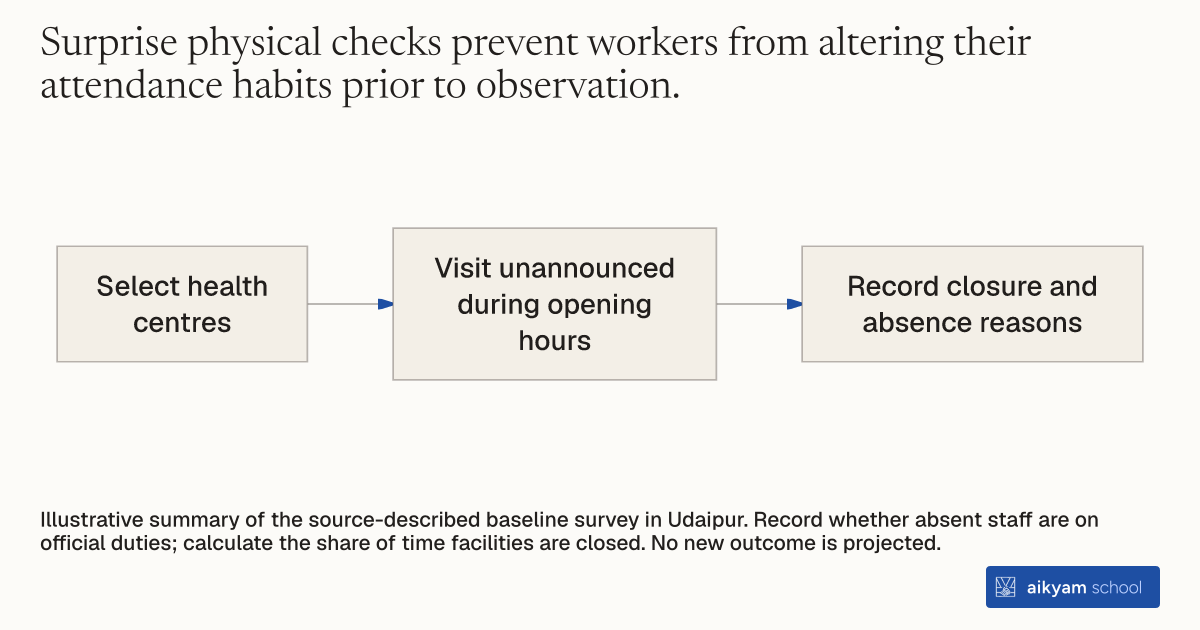
- Select health centres
- Visit unannounced during opening hours
- Record closure and absence reasons
Illustrative summary of the source-described baseline survey in Udaipur. Record whether absent staff are on official duties; calculate the share of time facilities are closed. No new outcome is projected.
See source →How
When to use
Public healthcare facilities in low-income rural areas suffer from chronic staff absenteeism. Local populations abandon government health centers when facilities remain closed during regular business hours. Conduct unannounced survey visits to measure actual facility opening rates and provider absence before designing interventions.
Conduct surprise physical inspections of rural health centers to measure baseline staff presence and facility opening times.
- Select a representative sample of public health centers serving rural villages.
- Send field officers on unannounced visits to each health facility during regular operating hours.
- Record whether the facility is open or closed during each unannounced visit.
- Verify if absent staff members are performing official field duties or are simply missing.
- Calculate the baseline percentage of time health centers remain closed due to unannounced worker absence.
Why it works
Direct observation provides accurate data on service availability that official administrative logs often conceal.
Example
Researchers and Seva Mandir surveyed health facilities in 100 villages across Udaipur District, India. They checked whether Primary Health Centers and subcenters were open during scheduled business hours of six days a week and six hours a day. The survey revealed that clinics were closed 56 percent of the time, with staff on duty elsewhere only 12 percent of the time.
About the study
Participants
100 local health centers serving rural villages in Udaipur District, Rajasthan, India.
Study Design
Field survey using unannounced physical visits by field officers during regular business hours to observe clinic operation and nurse presence.
Results
Clinics were closed 56 percent of the time during business hours, and 75 percent of patients sought care from expensive private providers or traditional healers.