Try, learn and adjust
Check photographs against planned camp dates
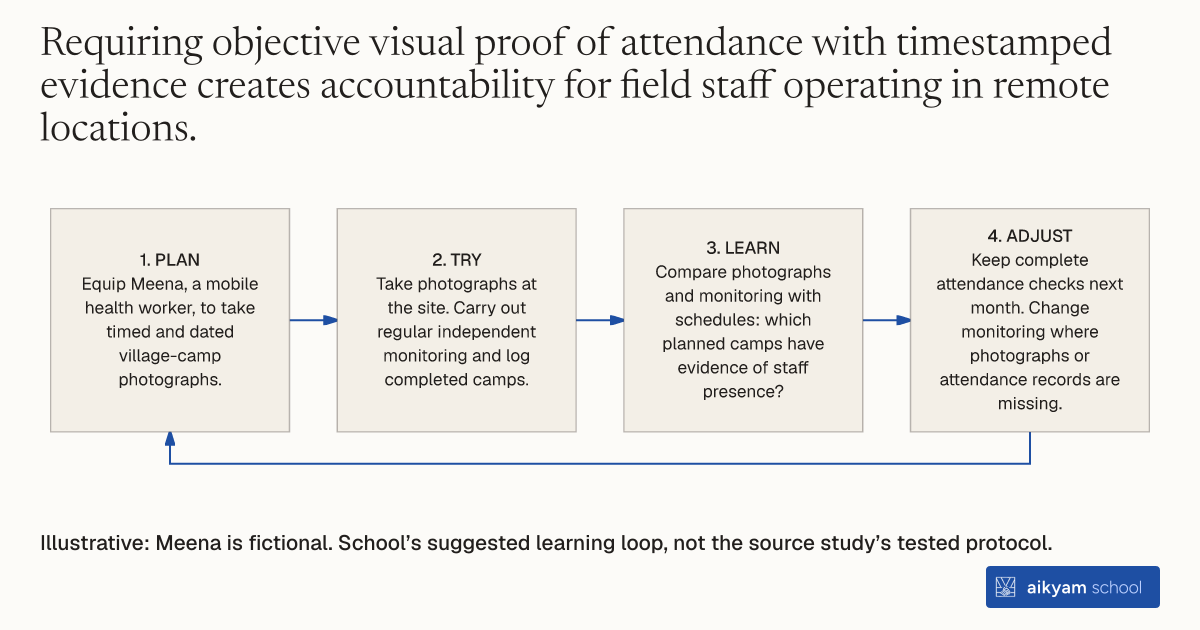
- Plan: Equip Meena, a mobile health worker, to take timed and dated village-camp photographs.
- Try: Take photographs at the site. Carry out regular independent monitoring and log completed camps.
- Learn: Compare photographs and monitoring with schedules: which planned camps have evidence of staff presence?
- Adjust: Keep complete attendance checks next month. Change monitoring where photographs or attendance records are missing.
Illustrative: Meena is fictional. School’s suggested learning loop, not the source study’s tested protocol.
See source →School’s suggested, untested loop. Observe timed photographs, independent visits and completed-camp logs. Do not infer health effects from staff presence.
How
When to use
Public health facilities in rural areas experience severe healthcare provider absenteeism, reaching 45 percent among field staff. Unpredictable provider absences undermine community trust and discourage parents from seeking preventative services. Monitor staff presence at remote service sites using timed and dated photographs to enforce attendance standards.
Verify staff presence at mobile service sites using timed and dated photographs combined with regular independent monitoring.
- Equip mobile health staff, including Auxiliary Nurse Midwives, with camera devices during field assignments.
- Require staff to take timed and dated photographs of themselves operating at the village camp site.
- Conduct regular independent monitoring visits to verify physical attendance and record keeping.
- Review submitted photographic evidence against planned clinic schedules to track worker compliance.
- Maintain systematic logs of completed camps to ensure staff presence across all target locations.
Why it works
Direct monitoring deters unannounced absences and ensures healthcare services run as scheduled.
Example
In rural Udaipur, India, NGO Seva Mandir monitored mobile immunization teams by requiring timed and dated photographs at each village camp alongside regular supervision. This verification system ensured 95 percent of planned monthly camps took place without provider absence disruption.
About the study
Participants
134 villages with almost 2,000 children under five in Udaipur District, Rajasthan, India.
Study Design
Clustered randomized controlled trial testing mobile health camps with photographic attendance monitoring and supervision in remote villages.
Results
Records indicate that 95 percent of planned camps took place and were not disrupted by provider absence, compared to a 45 percent baseline absenteeism rate among public health staff in the region.