Research procedure
Check smoking status at twelve months
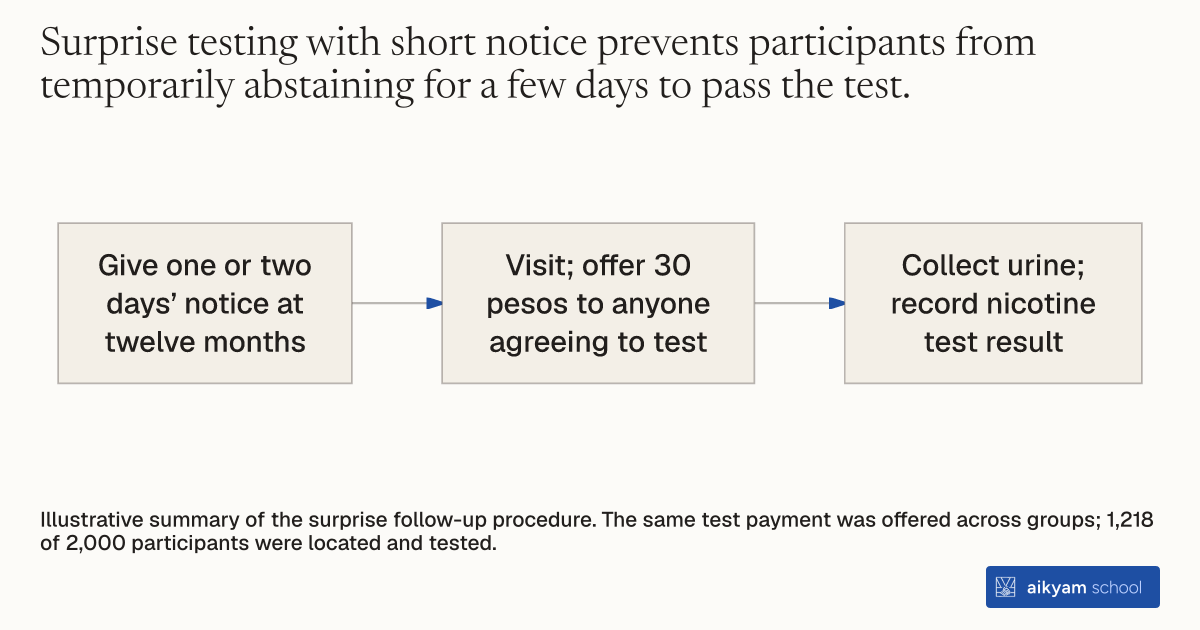
- Give one or two days’ notice at twelve months
- Visit; offer 30 pesos to anyone agreeing to test
- Collect urine; record nicotine test result
Illustrative summary of the surprise follow-up procedure. The same test payment was offered across groups; 1,218 of 2,000 participants were located and tested.
See source →How
When to use
Participants may briefly stop smoking right before a scheduled test without making long-term behavioral changes. Conducting unannounced follow-up tests with cash incentives measures whether a health program produces lasting smoking cessation. It helps researchers evaluate true long-term impact after financial contracts end.
Administer unannounced biochemical nicotine tests to participants twelve months after enrollment while offering equal cash compensation.
- Contact study participants twelve months after initial enrollment with a short notice of one or two days.
- Visit participants in person at their homes or workplaces.
- Offer a uniform payment of 30 pesos to every participant who agrees to take the test.
- Collect a urine sample and apply a chemical test strip for nicotine and cotinine.
- Record whether the test strip shows complete abstinence from nicotine.
Why it works
Offering equal financial rewards to all participants eliminates selection bias and ensures high response rates across groups.
Example
Green Bank field staff conducted unannounced 12-month urine tests with a 30 pesos payment across study participants in the Philippines, finding that 14 out of 29 six-month successful commitment clients remained non-smokers after one year.
About the study
Participants
2,000 adult regular smokers in Mindanao, Philippines, with 1,218 participants located and tested at 12 months.
Study Design
Unannounced 12-month follow-up evaluation in a randomized controlled trial offering 30 pesos incentive to test long-term persistence after all financial commitment contracts had expired.
Results
Unannounced testing at 12 months demonstrated that offering commitment accounts increased long-term smoking cessation by 3.4 to 5.7 percentage points over the control group.