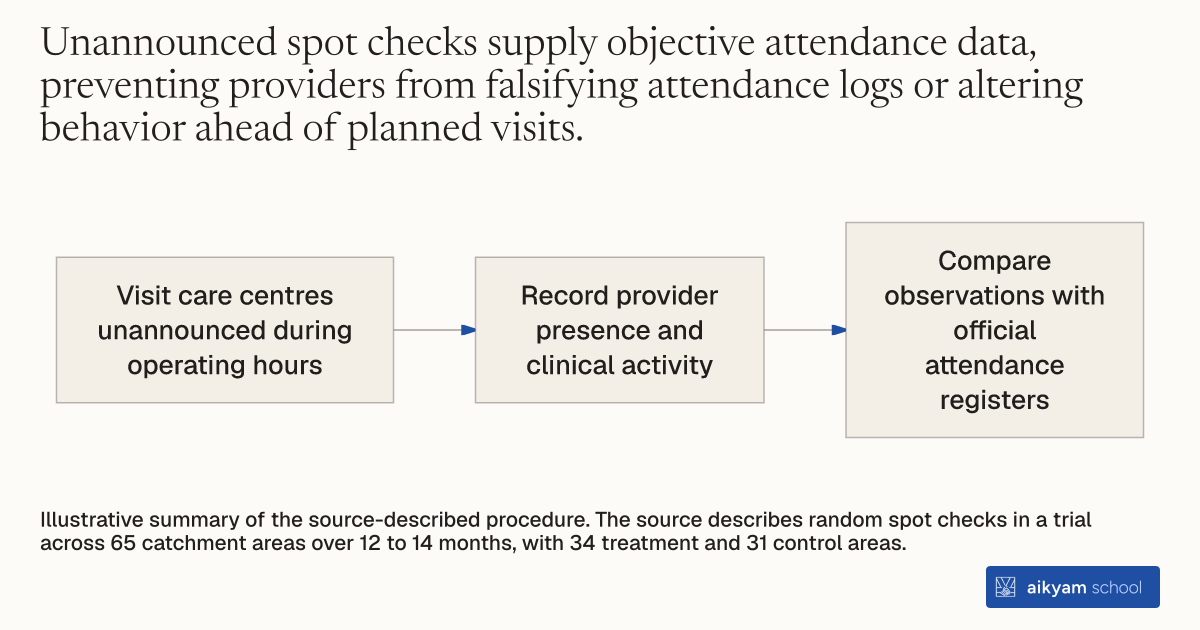
Research steps
Verify attendance without advance notice
- Visit care centres unannounced during operating hours
- Record provider presence and clinical activity
- Compare observations with official attendance registers
Illustrative summary of the source-described procedure. The source describes random spot checks in a trial across 65 catchment areas over 12 to 14 months, with 34 treatment and 31 control areas.
See source →How
When to use
In decentralized primary healthcare programs, self-reported health worker attendance logs are often inaccurate. Health workers may leave early or skip clinic shifts. Unannounced spot checks verify actual provider presence and evaluate whether monitoring interventions improve health worker attendance.
Conduct random unannounced audit visits to health facilities to observe provider presence and clinic operations.
- Assign independent evaluators to visit healthcare centers during operating hours without giving prior notice.
- Arrive at the health center during standard working hours.
- Observe whether the assigned health worker is present at the facility.
- Record provider activity and time spent conducting clinical care.
- Cross-check observed attendance against official registers to verify record accuracy.
Example
Evaluators conducted random spot checks across 65 tuberculosis centers in Northern India over 12 to 14 months, finding biometric tracking increased provider attendance from 59.8 percent to 66.9 percent.
About the study
Participants
65 catchment areas serving urban informal settlements across four states in Northern India, each serving nearly 40,000 individuals and managed by one health worker.
Study Design
Randomized controlled trial across 65 catchment areas (34 treatment and 31 control), conducting unannounced clinic spot checks, patient surveys, administrative audits, and day-long observations over 12 to 14 months.
Results
Random spot checks revealed provider attendance was 59.8 percent in comparison centers and increased by 7.1 percentage points (12 percent) to 66.9 percent in biometric-monitored centers.