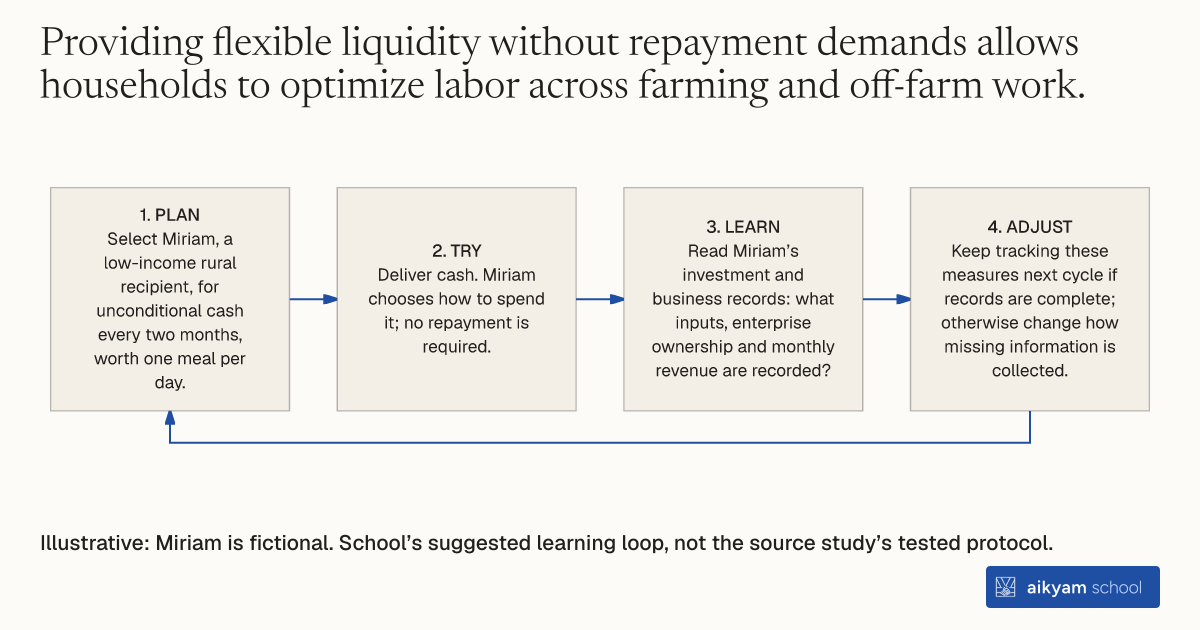
Try, learn and adjust
Check cash delivery and household investment
- Plan: Select Miriam, a low-income rural recipient, for unconditional cash every two months, worth one meal per day.
- Try: Deliver cash. Miriam chooses how to spend it; no repayment is required.
- Learn: Read Miriam’s investment and business records: what inputs, enterprise ownership and monthly revenue are recorded?
- Adjust: Keep tracking these measures next cycle if records are complete; otherwise change how missing information is collected.
Illustrative: Miriam is fictional. School’s suggested learning loop, not the source study’s tested protocol.
See source →Observe input investments, non-farm enterprise ownership and monthly business revenue. Do not treat this check as proof of impact.
How
When to use
Smallholder farming households lack capital to purchase basic inputs or start non-farm businesses. Traditional loans require rapid repayments that restrict flexible spending. Delivering unconditional cash transfers gives rural households financial security to invest in farming and establish new income streams.
Distribute flexible unconditional cash transfers to low-income rural households on a regular periodic schedule.
- Program administrators select low-income rural households or female family members to receive direct cash assistance.
- Disburse unconditional cash transfers every two months valued at the equivalent of one meal per day.
- Allow recipients complete freedom to spend cash on agricultural inputs, livestock, or non-farm small businesses.
- Track household input investments, off-farm enterprise ownership, and monthly business revenues.
Example
In Zambia, women offered cash transfers every two months worth one meal per day bought seeds, fertilizer, tools, and livestock. Recipients were more likely to own non-farm enterprises and made extra income equal to double their baseline per-person spending.
About the study
Participants
Rural women and agricultural households in Zambia.
Study Design
Randomized controlled trial evaluating bi-monthly unconditional cash transfers on agricultural input adoption, tool ownership, and off-farm business creation.
Results
Cash recipients spent more on seeds, fertilizer, tools, and livestock, owned more non-farm enterprises, and earned additional income equal to double their pre-transfer per-person spending.