Try, learn and adjust
Check vocational skills are used during shocks
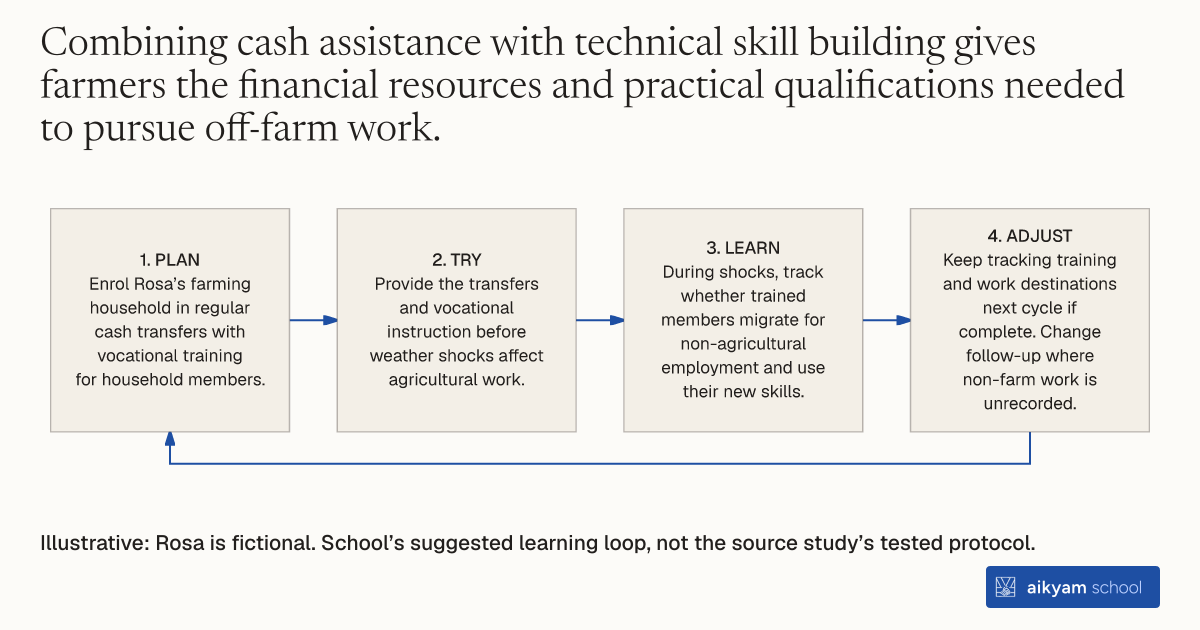
- Plan: Enrol Rosa’s farming household in regular cash transfers with vocational training for household members.
- Try: Provide the transfers and vocational instruction before weather shocks affect agricultural work.
- Learn: During shocks, track whether trained members migrate for non-agricultural employment and use their new skills.
- Adjust: Keep tracking training and work destinations next cycle if complete. Change follow-up where non-farm work is unrecorded.
Illustrative: Rosa is fictional. School’s suggested learning loop, not the source study’s tested protocol.
See source →School’s suggested, untested loop. Observe training, regular cash receipt and migration for non-agricultural work; do not assume every recipient migrates.
How
When to use
Weather shocks damage crop production and reduce agricultural earnings for smallholder farmers. Providing vocational training alongside social cash assistance prepares household members for alternative employment. It targets rural farming families facing recurring climate variability.
Deliver vocational training bundled with regular cash transfers to enable migration for non-agricultural work during climate shocks.
- Program administrators enroll rural agricultural households in a regular social cash transfer program.
- Training providers deliver vocational skill instruction to participating household members.
- Climatic shocks hit agricultural communities and impair crop yields.
- Trained household members apply vocational skills to migrate for off-farm employment during shock periods.
Why it works
Developing non-agricultural skills enables family members to seek employment outside affected farming areas when weather disasters hit.
Example
In Nicaragua, researchers evaluated agricultural households receiving vocational training alongside regular cash transfers. When climatic shocks occurred, recipient households leveraged their newly acquired technical skills and increased their likelihood of migrating for non-agricultural work compared to unsupported households.
About the study
Participants
Agricultural households in rural Nicaragua facing climatic shocks.
Study Design
Randomized controlled trial evaluating regular cash transfers combined with vocational training during climatic shocks.
Results
Beneficiaries receiving vocational training alongside regular cash transfers leveraged new technical skills when shocks occurred, significantly increasing their likelihood of migrating for non-agricultural employment.