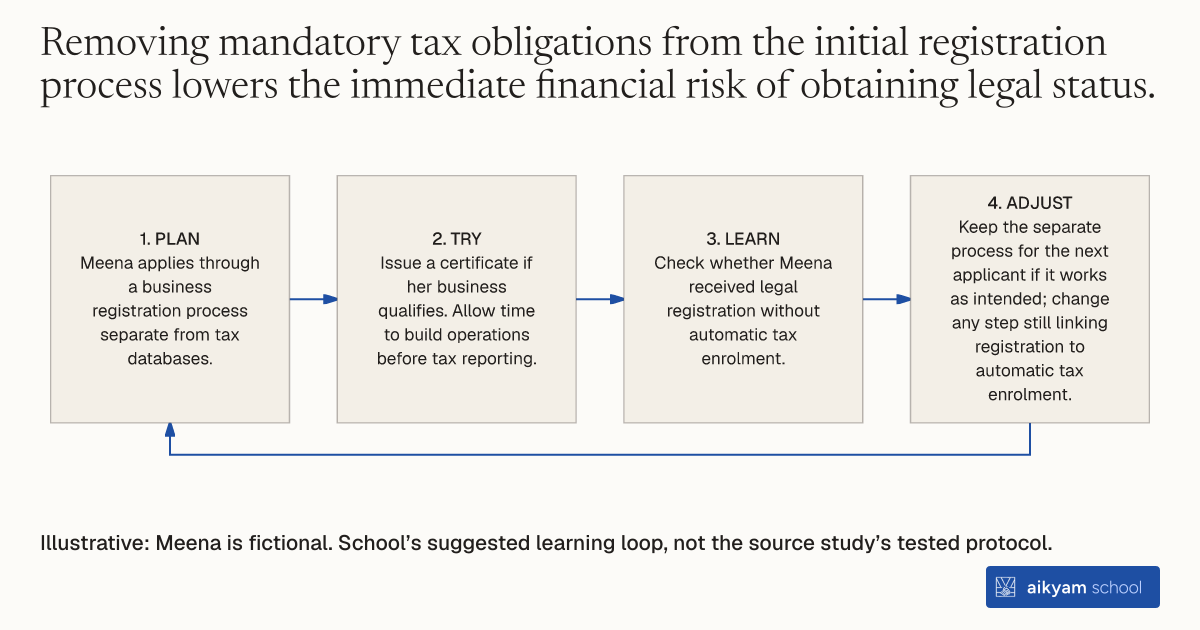
Try, learn and adjust
Check registration without automatic tax enrolment
- Plan: Meena applies through a business registration process separate from tax databases.
- Try: Issue a certificate if her business qualifies. Allow time to build operations before tax reporting.
- Learn: Check whether Meena received legal registration without automatic tax enrolment.
- Adjust: Keep the separate process for the next applicant if it works as intended; change any step still linking registration to automatic tax enrolment.
Illustrative: Meena is fictional. School’s suggested learning loop, not the source study’s tested protocol.
See source →School’s suggested, untested loop. Observe registration, certificates and separation from automatic tax enrolment.
How
When to use
Small informal business owners avoid legal registration because registration automatically triggers immediate tax liabilities. This situation leaves micro-enterprises outside official legal frameworks and restricts access to formal commercial opportunities. It applies to government registration authorities seeking to increase business formalization rates.
Separate official business registration procedures from tax collection databases and obligations.
- Establish an independent business registration process that operates separately from tax authority databases.
- Allow informal business owners to apply for legal business registration without requiring automatic tax enrollment.
- Issue legal business identification certificates to qualifying enterprise owners.
- Provide new business registrants with time to build enterprise operations before initiating tax reporting procedures.
Why it works
Entrepreneurs can secure legal business standing without fearing immediate tax penalties.
Example
In Malawi, researchers evaluated enterprise responses when business registration was separated from tax obligations, which significantly increased small company demand for business registration.
Source
See source →Evidence in Labor Market Policies and Implications for Brazil: Informality
Copyright © 2025 Inter-American Development Bank.
Full source notice
Copyright © 2025 Inter-American Development Bank ("IDB"). This work is subject to a Creative Commons license CC BY 3.0 IGO (https://creativecommons.org/licenses/by/3.0/igo/legalcode). The terms and conditions indicated in the URL link must be met and the respective recognition must be granted to the IDB. Further to section 8 of the above license, any mediation relating to disputes arising under such license shall be conducted in accordance with the WIPO Mediation Rules. Any dispute related to the use of the works of the IDB that cannot be settled amicably shall be submitted to arbitration pursuant to the United Nations Commission on International Trade Law (UNCITRAL) rules. The use of the IDB's name for any purpose other than for attribution, and the use of IDB's logo shall be subject to a separate written license agreement between the IDB and the user and is not authorized as part of this license. Note that the URL link includes terms and conditions that are an integral part of this license.