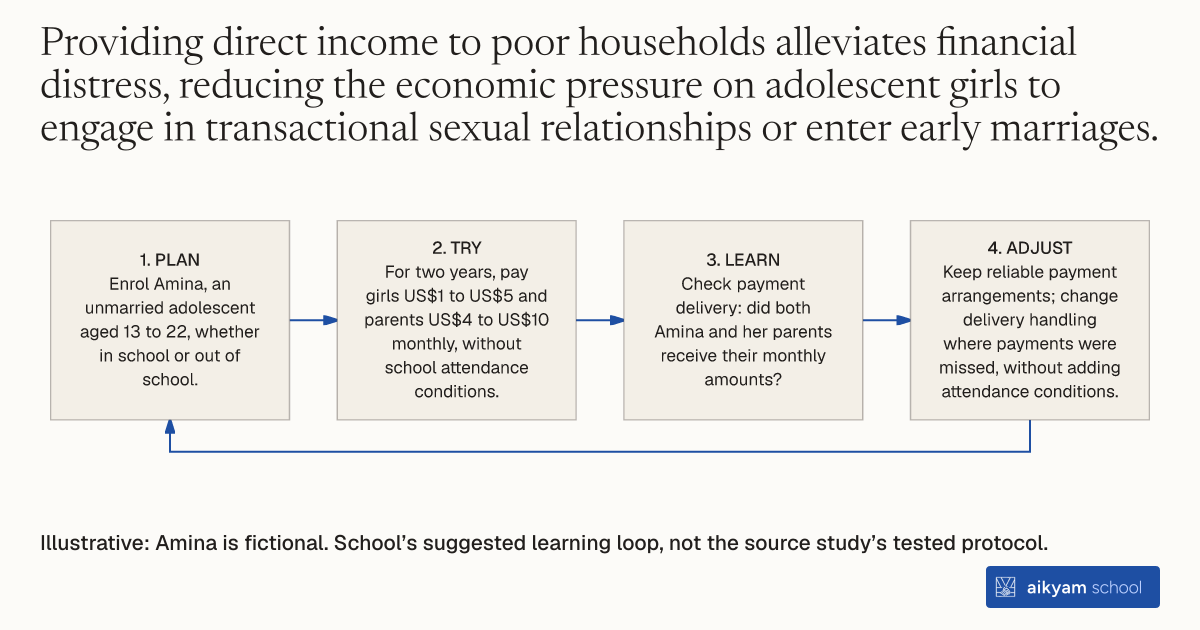
Try, learn and adjust
Check monthly unconditional payments
- Plan: Enrol Amina, an unmarried adolescent aged 13 to 22, whether in school or out of school.
- Try: For two years, pay girls US$1 to US$5 and parents US$4 to US$10 monthly, without school attendance conditions.
- Learn: Check payment delivery: did both Amina and her parents receive their monthly amounts?
- Adjust: Keep reliable payment arrangements; change delivery handling where payments were missed, without adding attendance conditions.
Illustrative: Amina is fictional. School’s suggested learning loop, not the source study’s tested protocol.
See source →School’s suggested loop, not a tested source procedure. Observe regular receipt and stated amounts; this check is not an attendance compliance test or proof of pregnancy effects.
How
When to use
Adolescent females in low-income settings may enter transactional sexual relationships or early marriages to meet economic needs. Providing monthly unconditional cash transfers directly to adolescent girls and their parents mitigates household poverty without schooling requirements. This approach targets unmarried female students and dropouts aged 13 to 22.
Distribute monthly unconditional cash transfers directly to unmarried adolescent females and their parents over a two-year period.
- Program administrators enroll unmarried female adolescents aged 13 to 22, including enrolled students and out-of-school dropouts.
- Program staff calculate monthly payment amounts for both parents and adolescent daughters.
- Program staff disburse monthly transfers of US$1 to US$5 directly to participating adolescent girls.
- Program staff disburse monthly transfers of US$4 to US$10 directly to the girls' parents.
- Administrators deliver payments regularly for two years without requiring school attendance or compliance checks.
Why it works
Reaching out-of-school dropouts directly allows unconditional transfers to protect vulnerable adolescents who cannot attend school.
Example
In Malawi from 2007 to 2010, two years of monthly unconditional cash transfers to unmarried females aged 13 to 22 and their parents reduced pregnancy rates at the end of the program by 6.7 percentage points (27 percent), from 24.7 percent down to 18 percent.