Try, learn and adjust
Check message forwarding with costs covered
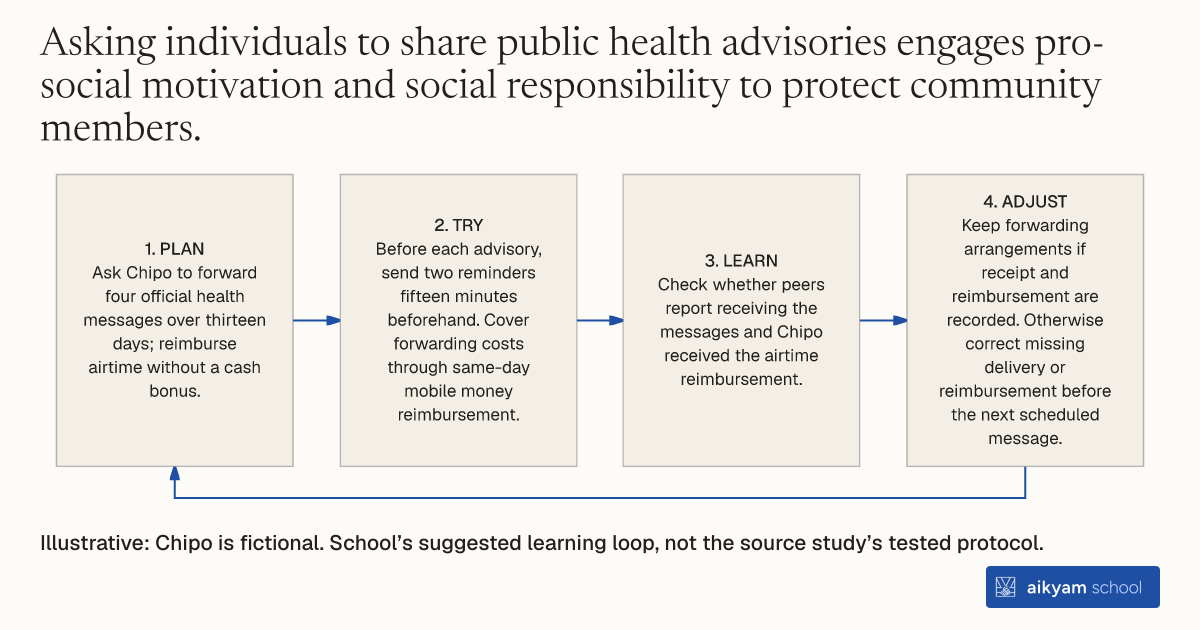
- Plan: Ask Chipo to forward four official health messages over thirteen days; reimburse airtime without a cash bonus.
- Try: Before each advisory, send two reminders fifteen minutes beforehand. Cover forwarding costs through same-day mobile money reimbursement.
- Learn: Check whether peers report receiving the messages and Chipo received the airtime reimbursement.
- Adjust: Keep forwarding arrangements if receipt and reimbursement are recorded. Otherwise correct missing delivery or reimbursement before the next scheduled message.
Illustrative: Chipo is fictional. School’s suggested learning loop, not the source study’s tested protocol.
See source →School’s suggested, untested loop: observe reported peer receipt and cost reimbursement. The trial found no statistically significant precautionary behaviour changes.
How
When to use
Public health authorities during epidemics need scalable ways to disseminate protective guidance without relying solely on direct broadcast channels. Central government messages can face skepticism or low engagement in local communities. Peer text message forwarding leverages existing social ties and intrinsic motivation to pass official health advisories to friends and relatives without providing cash rewards.
Encourage primary survey participants to forward official health text messages to their peer contact lists while covering their messaging costs.
- Send an official health text message covering a specific precautionary behavior to primary participants on scheduled campaign days.
- Send two reminder SMSs fifteen minutes prior to the health message asking primary participants to forward the text to their listed contacts.
- Transfer mobile money to primary participants on the same day to reimburse the exact airtime cost of sending the SMSs.
- Avoid offering any cash bonuses or monetary incentives for forwarding compliance.
- Repeat the message delivery process for four health messages over a 13-day intervention period.
Why it works
Reimbursing direct airtime costs eliminates the financial friction of passing messages without undermining the intrinsic credibility of the health advice.
Example
In Zambia, primary participants receiving messages attributed to the Ministry of Health were asked to forward health SMSs to up to 5 peer contacts without financial incentives, increasing reported peer message receipt by 13.1 percentage points by survey round 3 compared to 28% in the control group.
About the study
Participants
729 primary participants and 2,030 peer contacts in Zambia; primary participants were aged 18+, 45.7% female, 47.6% aged 20-29, 45.9% with secondary education, and 34.6% residing in Lusaka.
Study Design
Randomized controlled trial comparing peer forwarding without financial incentives (T1) against a control group (T0), incentivized forwarding (T2), and direct health authority messaging (T3) across three endline survey rounds.
Results
In round 3, unincentivized peer forwarding increased reported message receipt by 13.1 percentage points for Ministry of Health messages and 12.1 percentage points for ZNPHI messages over the control baseline (28%), but produced no statistically significant changes in precautionary health behaviors like handwashing (35% in control) or mask wearing (8% in control).