Try, learn and adjust
Check quantity-based waste charges
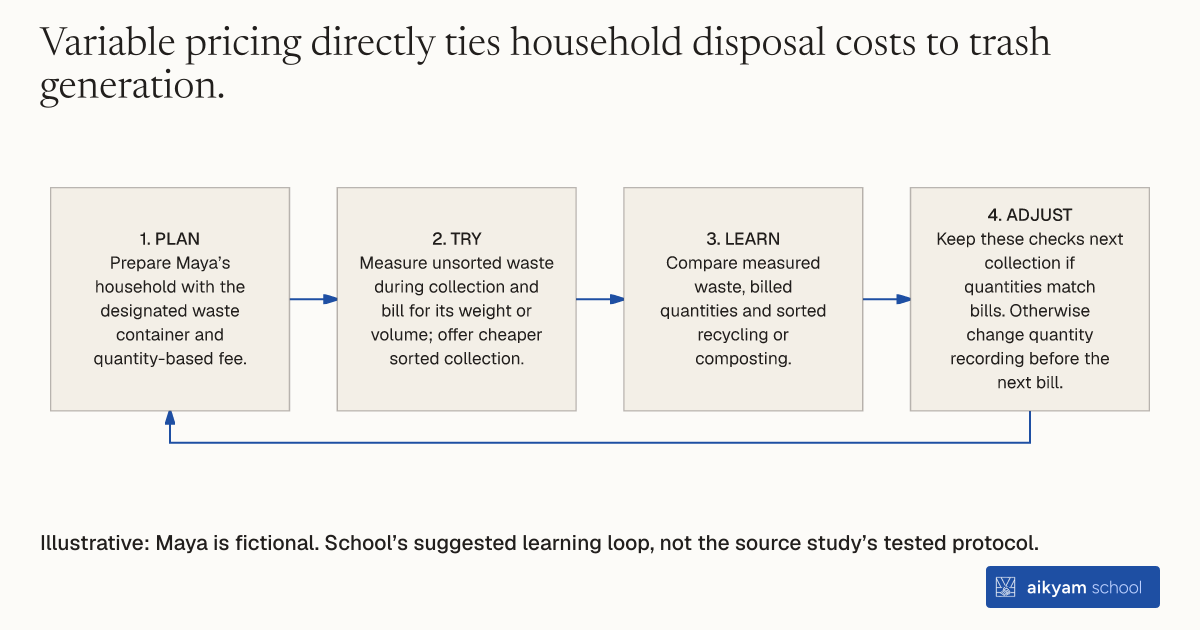
- Plan: Prepare Maya’s household with the designated waste container and quantity-based fee.
- Try: Measure unsorted waste during collection and bill for its weight or volume; offer cheaper sorted collection.
- Learn: Compare measured waste, billed quantities and sorted recycling or composting.
- Adjust: Keep these checks next collection if quantities match bills. Otherwise change quantity recording before the next bill.
Illustrative: Maya is fictional. School’s suggested learning loop, not the source study’s tested protocol.
See source →School’s suggested, untested learning loop. Observe unsorted waste quantities, bills and sorted waste; weight and volume pricing differ.
How
When to use
Municipalities face high volumes of unsorted solid waste sent to landfills, generating significant methane emissions. Traditional flat-rate waste fees give households no financial incentive to minimize trash or separate recyclables. Unit-based pricing charges households based on the volume or weight of garbage they dispose of.
Charge households variable fees based on the amount of unsorted solid waste they produce.
- Select a variable fee structure, prioritizing weight-based pricing over volume-based container options.
- Distribute designated trash containers, branded bags, or automated weigh-scale bins to residential properties.
- Track household unsorted waste quantities during scheduled garbage collection cycles.
- Bill households based on measured weight or container volume consumed per disposal period.
- Provide free or lower-cost collection options for sorted organic waste and dry recyclables.
Why it works
Charging by weight prevents households from compressing garbage into smaller containers and strongly encourages sorting recyclables and compostables to lower utility bills.
Example
Municipalities across the Netherlands, Italy, Switzerland, and Japan implemented unit-based pricing programs for residential garbage collection. Evaluators found that unit-based fees consistently reduced unsorted solid waste and increased recycling rates, with weight-based systems outperforming volume-based pricing.
About the study
Participants
Residential households across municipalities in the Netherlands, Italy, Switzerland, Japan, and Taiwan.
Study Design
Difference-in-differences, two-way fixed effects, and quasi-experimental panel evaluations comparing municipal waste diversion rates.
Results
Unit-based pricing significantly reduced unsorted solid waste and increased sorted recycling and composting rates over long time horizons. Weight-based pricing systems proved more effective at waste reduction than volume-based systems because they prevented trash compaction in containers.