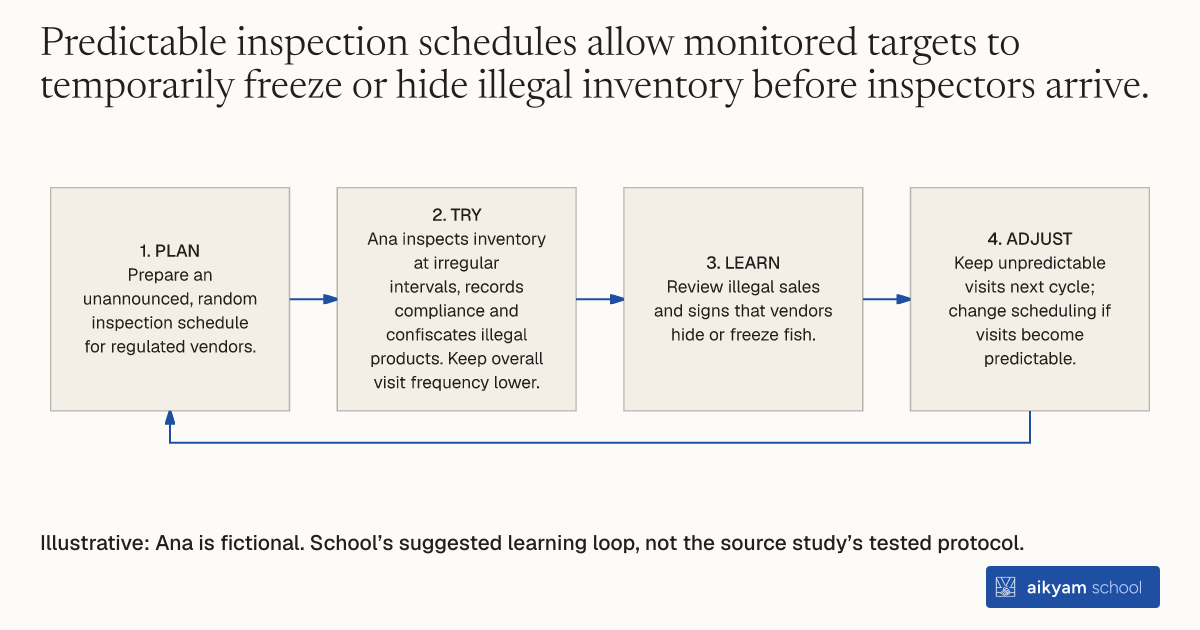
Try, learn and adjust
Check unpredictable inspection visits
- Plan: Prepare an unannounced, random inspection schedule for regulated vendors.
- Try: Ana inspects inventory at irregular intervals, records compliance and confiscates illegal products. Keep overall visit frequency lower.
- Learn: Review illegal sales and signs that vendors hide or freeze fish.
- Adjust: Keep unpredictable visits next cycle; change scheduling if visits become predictable.
Illustrative: Ana is fictional. School’s suggested learning loop, not the source study’s tested protocol.
See source →School’s suggested learning loop; not a tested source procedure. Observe compliance and evasion. The source describes endangered hake sales in Chile; it gives no numerical visit frequency.
How
When to use
Regulated entities learn predictable inspection patterns and temporarily hide illegal activities during known enforcement visits. Scheduled monitoring allows illegal sellers to circumvent environmental rules without changing long-term compliance. This method applies to regulatory enforcement agencies seeking to prevent regulated firms from evading inspections.
Conduct regulatory inspection visits on an unpredictable and less frequent schedule to prevent regulated entities from circumventing enforcement.
- The regulatory enforcement agency identifies targeted vendors and commercial facilities subject to environmental rules.
- The agency generates an unannounced, randomized inspection schedule rather than a fixed calendar visit pattern.
- Government inspectors conduct unannounced monitoring visits at irregular intervals to inspect vendor inventory.
- Inspectors record compliance and confiscate illegally harvested products found at the site.
- The agency maintains lower overall visit frequency to prevent monitored targets from learning enforcement routines in Chile.
Why it works
Varying inspection timing deprives entities of notice, making evasion costly and impractical.
Example
In Chile, government inspectors conducted randomized monitoring visits to vendors illegally selling endangered hake fish, where unpredictable and less-frequent monitoring reduced illegal fish sales substantially while predictable schedules failed because vendors hid fish.
About the study
Participants
Vendors illegally selling endangered hake fish in Chile.
Study Design
Randomized field experiment varying the frequency and predictability of government monitoring visits.
Results
Predictable inspection visits failed because vendors hid or froze fish, while unpredictable and less-frequent monitoring reduced illegal fish sales substantially.