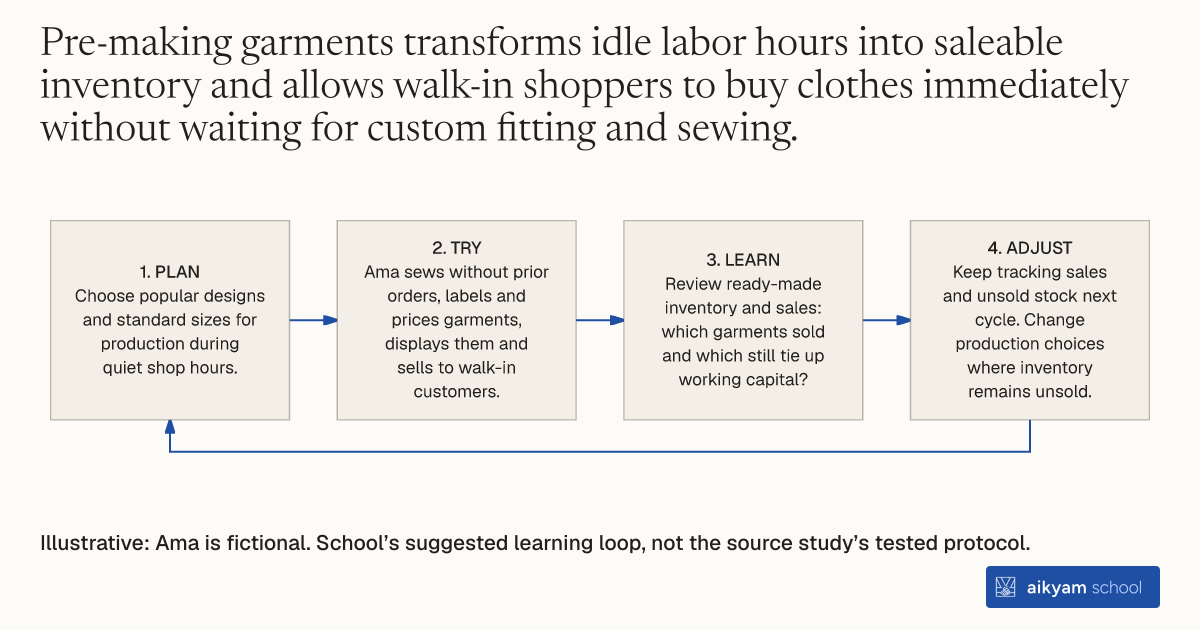
Try, learn and adjust
Check ready-made garment sales and stock exposure
- Plan: Choose popular designs and standard sizes for production during quiet shop hours.
- Try: Ama sews without prior orders, labels and prices garments, displays them and sells to walk-in customers.
- Learn: Review ready-made inventory and sales: which garments sold and which still tie up working capital?
- Adjust: Keep tracking sales and unsold stock next cycle. Change production choices where inventory remains unsold.
Illustrative: Ama is fictional. School’s suggested learning loop, not the source study’s tested protocol.
See source →School’s suggested, untested loop. Observe inventory, cash sales and working capital exposure; the full treatment sample did not show higher average profits.
How
When to use
Tailors traditionally produce custom garments only after receiving a paid customer order, leaving shop capacity idle during slow periods. Producing ready-to-wear garments without an advance client commitment creates immediate inventory for walk-in shoppers. This method serves microenterprise tailors who want to attract new buyers and smooth production cycles.
Sew finished garments without a specific client order and display them in the shop for immediate retail sale.
- Select popular garment designs and standard sizes using readily available shop fabrics.
- Produce completed clothing items during slow business hours when custom customer orders are light.
- Affix shop branding labels and pricing tags to the finished garments.
- Display the completed clothes on hangers or racks inside the shop where passing foot traffic can see them.
- Sell the ready-to-wear inventory directly to walk-in customers for immediate cash payment.
Example
A 28-year-old tailor named Sarah in Accra, Ghana, adopted "sew and sell" under guidance from an Ernst & Young consultant, sewing finished products without prior orders and displaying them in her concrete shop. By combining ready-to-wear sales with shop improvements, Sarah increased her monthly profits from 90 cedis in December 2008 to 333 cedis in December 2010.
About the study
Participants
160 urban microenterprise tailors and seamstresses in Accra, Ghana.
Study Design
Randomized Controlled Trial evaluating marketing advice and business practice adoption across 8 survey waves over two years.
Results
Consultants reported tailors were very receptive to marketing discussions like "sew and sell," but adopting speculative inventory practices increased working capital exposure and did not raise average profits across the full treatment sample.