Research steps
Track respondents through village leaders
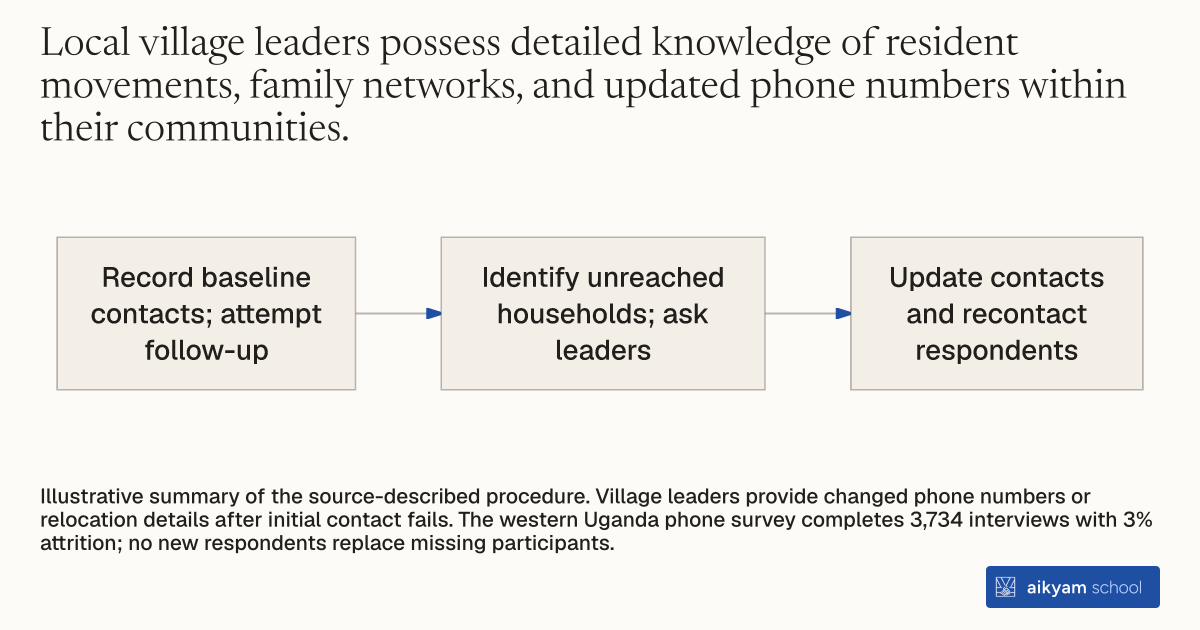
- Record baseline contacts; attempt follow-up
- Identify unreached households; ask leaders
- Update contacts and recontact respondents
Illustrative summary of the source-described procedure. Village leaders provide changed phone numbers or relocation details after initial contact fails. The western Uganda phone survey completes 3,734 interviews with 3% attrition; no new respondents replace missing participants.
See source →How
When to use
In longitudinal research and panel evaluations in low-income rural regions, researchers frequently face high survey attrition when respondents migrate or change contact details. Utilizing village leaders to locate uncontacted participants and update telephone numbers maintains high follow-up rates across survey rounds. This method suits field researchers and survey managers conducting multi-wave panel evaluations in remote agricultural settings.
Maintain low attrition in follow-up panel surveys by partnering with local village chairpersons and community leaders to locate unreached respondents and update phone numbers.
- Compile an initial respondent contact directory during baseline in-person household surveys, recording primary mobile numbers and household head identifiers.
- Initiate follow-up surveys, such as a lean-season phone survey, by attempting direct contact with all baselined households.
- Identify unreached respondents who have changed phone numbers, moved away, or remain unavailable after initial call attempts.
- Engage local village chairpersons and community leaders to track down missing or uncontacted study participants within their communities.
- Obtain updated phone numbers or current relocation details for missing respondents directly from village leadership.
- Re-contact the located respondents using the updated information to complete follow-up survey interviews.
Why it works
Partnering with leaders enables survey teams to locate previously unreachable households quickly and maintain high sample retention.
Example
Researchers conducting a lean-season phone survey across 335 rural villages in western Uganda partnered with village chairpersons to locate unreached households, achieving an extremely low survey attrition rate of 3%.
About the study
Participants
3,852 households across 335 villages in Kagadi and Kyenjojo districts, western Uganda, where 35% of households fall below the \$2.15 PPP daily poverty line post-harvest and 65% during the lean season.
Study Design
Clustered randomized controlled trial across 114 village clusters covering 335 villages, comparing a universal livelihoods program to a pure control group using a 19-minute lean-season phone survey.
Results
Utilizing village leadership to locate uncontacted respondents reduced phone survey attrition to 3% (3,734 completed surveys), compared to 8% in-person endline attrition and 6% midline attrition, with attrition uncorrelated with treatment status.