Research design
Compare endline survey samples
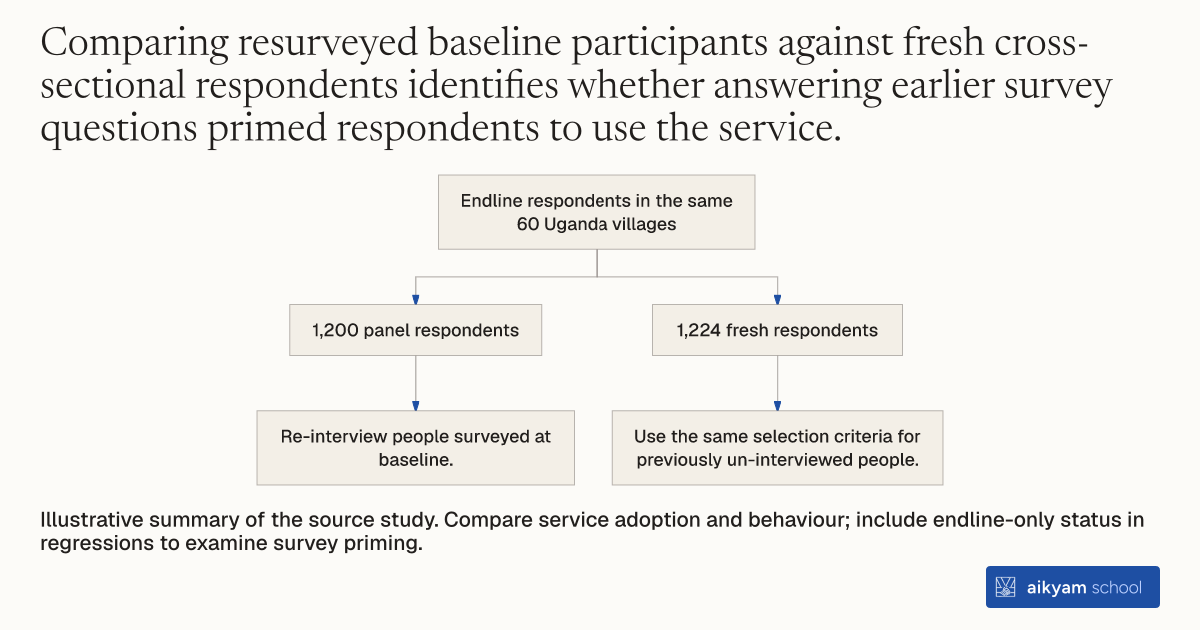
Endline respondents in the same 60 Uganda villages
- 1,200 panel respondents
- Re-interview people surveyed at baseline.
- 1,224 fresh respondents
- Use the same selection criteria for previously un-interviewed people.
Illustrative summary of the source study. Compare service adoption and behaviour; include endline-only status in regressions to examine survey priming.
See source →How
When to use
Repeatedly surveying the same individuals can inadvertently influence their awareness, attitudes, or behavior. Subjecting baseline participants to questions about health or new digital services might prime them to adopt those services at higher rates than unstudied populations. This method splits the endline sample into panel resurveyed participants and fresh cross-sectional respondents to measure and control for survey-induced hawthorne effects.
Control for survey priming effects during endline evaluation by combining panel resurveying with new cross-sectional sampling.
- Survey managers conduct baseline interviews with a randomized sample of eligible community members.
- Evaluators re-interview a randomly selected subset of original baseline participants during the follow-up survey wave.
- Field enumerators recruit an equal-sized sample of fresh, previously un-interviewed respondents from the same communities using identical baseline selection criteria.
- Analysts compare service adoption and behavioral outcomes between panel resurveyed participants and fresh cross-sectional respondents.
- Researchers include indicator variables for endline-only respondents in OLS impact regression models to isolate treatment effects from survey measurement priming.
Why it works
Controlling for endline-only status ensures that treatment effect estimates reflect genuine intervention impacts rather than survey measurement artifacts.
Example
Jamison, Karlan, and Raffler re-interviewed 1,200 baseline respondents and added 1,224 new cross-sectional respondents across 60 villages in central Uganda during endline evaluation to test if baseline surveying primed service usage.
About the study
Participants
2,424 adults aged 18 to 35 with at least six years of primary education (1,200 resurveyed panel participants and 1,224 fresh cross-sectional participants) in 60 villages across Masaka, Mpigi, Mityana, and Mubende districts in central Uganda.
Study Design
Clustered RCT methodology combining a longitudinal panel sub-sample with a fresh cross-sectional endline sub-sample to test for survey effects.
Results
Evaluators included an endline-only indicator variable in regression models to control for panel survey priming, ensuring unbiased intention-to-treat estimates across outcome indices.