Research tracking
Use intensive tracking after local searches
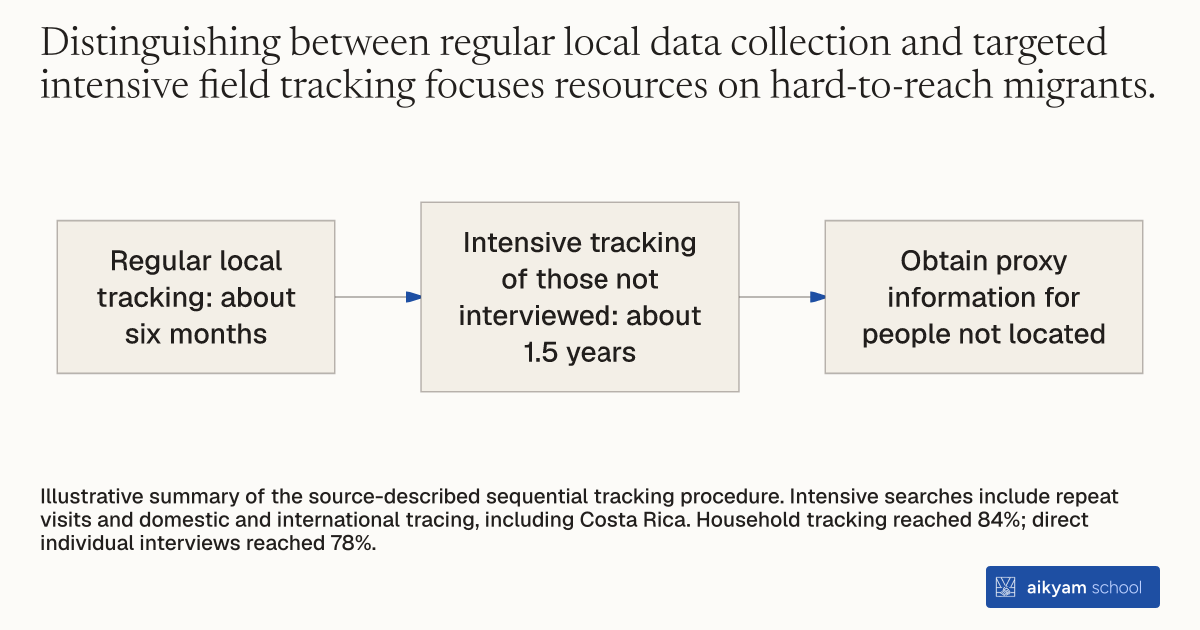
- Regular local tracking: about six months
- Intensive tracking of those not interviewed: about 1.5 years
- Obtain proxy information for people not located
Illustrative summary of the source-described sequential tracking procedure. Intensive searches include repeat visits and domestic and international tracing, including Costa Rica. Household tracking reached 84%; direct individual interviews reached 78%.
See source →How
When to use
Longitudinal evaluation teams face severe attrition when tracking mobile cohorts of young adults over long horizons. High attrition compromises sample balance and internal validity. Implementing a sequential two-phase tracking protocol combines local community surveying with extensive nationwide and international field searches to minimize panel attrition in longitudinal studies.
Track longitudinal survey participants through a sequential two-phase strategy that combines local village visits with intensive cross-border search protocols.
- Survey teams conduct a regular tracking phase lasting approximately six months to locate and interview respondents in or near their original baseline communities.
- Survey teams initiate an intensive tracking phase lasting approximately 1.5 years for all participants not interviewed during the regular phase.
- Field trackers conduct repeat visits to original localities to interview temporary labor migrants upon their return.
- Field trackers trace and interview permanent domestic migrants across all destination municipalities nationwide.
- Specialized international survey teams travel to major migrant destination countries—such as Costa Rica—to locate and interview international migrants in person.
- Surveyors interview proxy informants in original baseline households to obtain core demographic, educational, and employment status for individuals who cannot be physically located.
Why it works
Direct tracking combined with proxy reporting reduces overall sample loss, preserves baseline balance across study arms, and mitigates attrition bias.
Example
In the ten-year follow-up evaluation of the Nicaraguan Red de Protección Social CCT program, researchers tracked girls aged 9 to 12 at baseline across a two-phase survey from 2009 to 2011. Regular tracking and 1.5 years of intensive tracking across Nicaragua and Costa Rica yielded an 84 percent final tracking rate for household surveys, maintaining balanced attrition rates between early (15.1 percent) and late (15.1 percent) treatment groups.
About the study
Participants
1,062 young women aged 19 to 22 (originally aged 9 to 12 at baseline in 2000) across 42 rural comarcas in central and northern Nicaragua.
Study Design
Sequential longitudinal tracking evaluation comprising a 6-month regular phase and a 1.5-year intensive tracking phase across Nicaragua and Costa Rica, supplemented by proxy reports.
Results
Two-phase tracking achieved an 84 percent tracking rate for household interviews (16 percent attrition) and 78 percent for individual direct interviews (22 percent attrition), with attrition rates perfectly balanced between early and late treatment arms (p-value = 0.794).