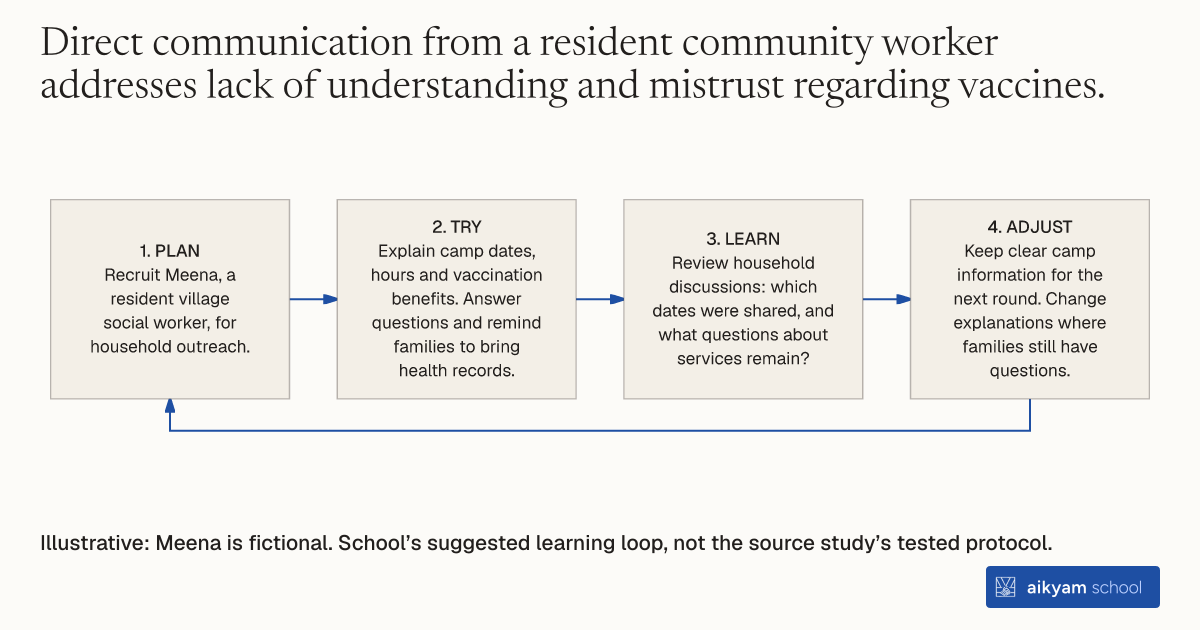
Try, learn and adjust
Check families receive monthly camp information
- Plan: Recruit Meena, a resident village social worker, for household outreach.
- Try: Explain camp dates, hours and vaccination benefits. Answer questions and remind families to bring health records.
- Learn: Review household discussions: which dates were shared, and what questions about services remain?
- Adjust: Keep clear camp information for the next round. Change explanations where families still have questions.
Illustrative: Meena is fictional. School’s suggested learning loop, not the source study’s tested protocol.
See source →School’s suggested, untested loop. Observe household outreach, dates communicated and questions raised. Outreach and camps were evaluated together.
How
When to use
In rural communities with low health literacy, families often lack understanding regarding the benefits of vaccination or hold suspicion toward public health services. Unreliable healthcare delivery further discourages clinic attendance, leaving children vulnerable to preventable diseases. Station a resident village social worker to inform mothers about upcoming clinics and educate families on childhood immunization.
Deploy a resident village social worker to conduct home visits that inform mothers about available immunization camps and educate them on health benefits.
- Recruit a local social worker who resides directly within each targeted village.
- Visit mothers in their homes to inform them of fixed monthly camp dates and hours.
- Educate parents on the health benefits of completing the full package of immunizations.
- Answer parental questions to address suspicions regarding government health services.
- Remind families before each scheduled camp to bring their child's official health card.
Why it works
Timely notifications reduce information barriers so mothers know exactly when reliable mobile services arrive.
Example
In tribal villages in Udaipur district, India, NGO Seva Mandir deployed resident social workers alongside monthly mobile clinics. Combining social worker education with reliable camps raised the full immunization rate for children aged 1 to 3 years from a 2 percent baseline to 16.6 percent.
About the study
Participants
134 villages with almost 2,000 children under five in Udaipur District, Rajasthan, India.
Study Design
Clustered randomized controlled trial comparing villages receiving mobile camps with social worker outreach against comparison villages receiving standard services.
Results
Full immunization rates among children aged 1 to 3 years rose from 6.2 percent in comparison villages to 16.6 percent in outreach villages, making children 2.69 times as likely to be completely immunized.