Try, learn and adjust
Check outreach explains the next village camp
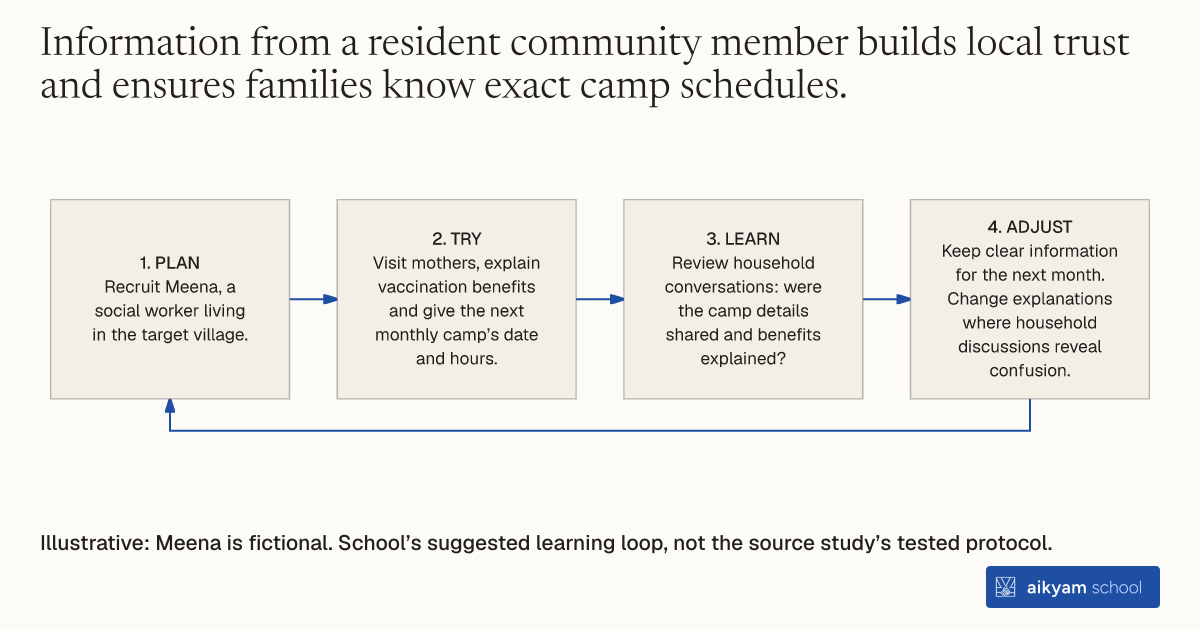
- Plan: Recruit Meena, a social worker living in the target village.
- Try: Visit mothers, explain vaccination benefits and give the next monthly camp’s date and hours.
- Learn: Review household conversations: were the camp details shared and benefits explained?
- Adjust: Keep clear information for the next month. Change explanations where household discussions reveal confusion.
Illustrative: Meena is fictional. School’s suggested learning loop, not the source study’s tested protocol.
See source →School’s suggested, untested loop. Observe outreach, scheduled hours and information shared. Full immunization effects concern outreach with reliable camps.
How
When to use
Parents in rural villages often lack clear information about scheduled health services and vaccine benefits. They procrastinate or skip visits due to low awareness and unreliable medical access. This method engages resident village workers to inform and educate mothers in remote communities.
Deploy a resident village social worker to conduct direct door-to-door community outreach and health education.
- Select a social worker who lives directly in the target village.
- The social worker visits local households to inform mothers about upcoming monthly immunization camps.
- The social worker educates mothers on the health benefits of full child vaccination.
- The social worker reminds parents to bring their children to the village camp during scheduled hours.
Why it works
Direct education clarifies the value of preventive health, helping mothers prioritize timely vaccination.
Example
Seva Mandir deployed resident social workers across 30 villages in Udaipur, India, to inform mothers about monthly immunization camps and educate them on child health. While camps with social worker outreach increased initial vaccine uptake to 78 percent, full immunization remained at 18 percent until in-kind incentives were introduced.
About the study
Participants
134 rural villages in Udaipur, India, involving families with children aged 1 to 3 years.
Study Design
Clustered randomized controlled evaluation comparing villages receiving mobile camps with social worker outreach to comparison villages.
Results
Social worker outreach and reliable monthly camps increased full immunization rates from 6 percent in comparison villages to 18 percent.