Try, learn and adjust
Check career guidance reaches practical activities
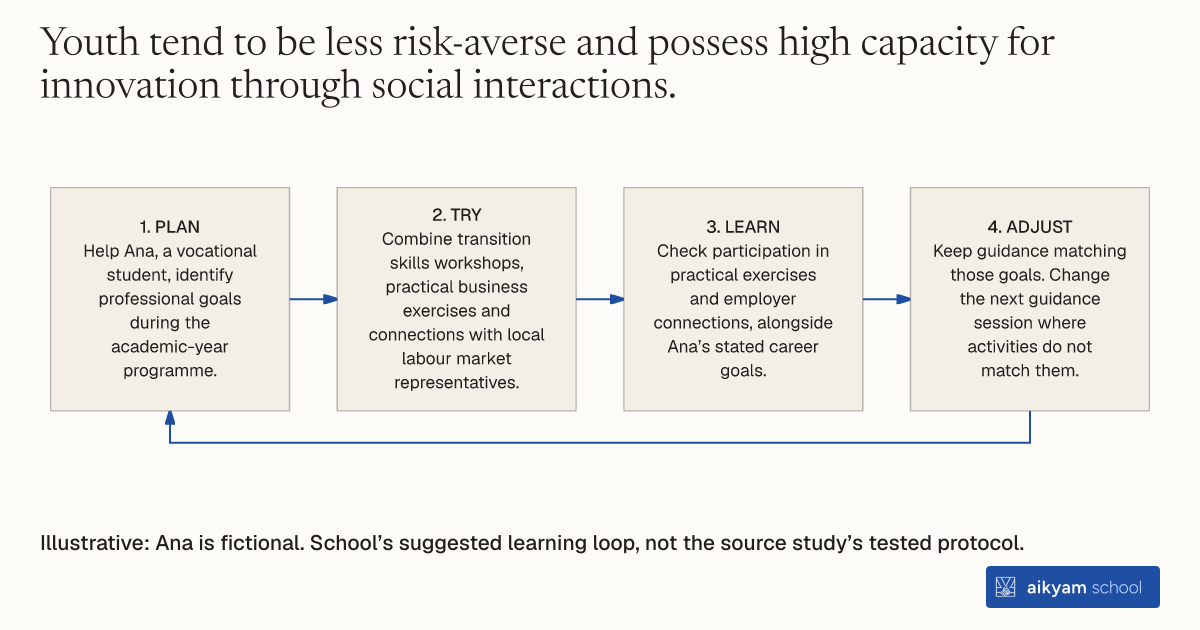
- Plan: Help Ana, a vocational student, identify professional goals during the academic-year programme.
- Try: Combine transition skills workshops, practical business exercises and connections with local labour market representatives.
- Learn: Check participation in practical exercises and employer connections, alongside Ana’s stated career goals.
- Adjust: Keep guidance matching those goals. Change the next guidance session where activities do not match them.
Illustrative: Ana is fictional. School’s suggested learning loop, not the source study’s tested protocol.
See source →School’s suggested, untested loop: observe guidance, exercises and connections; the trial found no short-term employment or business-starting intention effects.
How
When to use
Young students enrolled in vocational education across high-poverty regions face difficult transitions into the labor market and high school dropout rates. Standard academic curricula frequently lack practical business skill training and direct connections to local hiring industries. This method delivers career guidance and hands-on entrepreneurship training to keep vulnerable youth engaged in vocational education.
Deliver career guidance, education-to-work transition training, hands-on entrepreneurship experience, and employer connections to vocational students over an academic year.
- Vocational instructors deliver targeted career guidance sessions to help students identify professional goals.
- Trainers lead workshops on core competencies required for transitioning from school to the workforce.
- Facilitators guide students through hands-on activities to develop business skills and entrepreneurial mindsets.
- Program staff facilitate direct connections between students and local labor market representatives.
Why it works
Practical entrepreneurship projects paired with employer connections make vocational studies relevant, helping students stay in school.
Example
Fundación Ayuda en Acción delivered a full academic year entrepreneurship intervention to 5,727 students aged 16 to 25 across 51 vocational schools in Extremadura, Andalusia, and Galicia in Spain. The program provided career guidance, transition training, practical business exercises, and labor market networking. Participating students achieved lower dropout rates in further vocational education, enhanced job search skills, and modest gains in entrepreneurial attitudes.
About the study
Participants
5,727 students aged 16 to 25 enrolled in vocational education across 51 schools in Extremadura, Andalusia, and Galicia, Spain (3,032 treatment group, 2,695 comparison group).
Study Design
Cluster Randomised Controlled Trial (RCT) evaluating a one academic year entrepreneurship and career transition program implemented by Fundación Ayuda en Acción across 51 schools.
Results
The program significantly reduced the dropout rate in further vocational education, improved students' job search skills and perceived job search capacity, and produced modest increases in entrepreneurial attitudes and business behavior, though it had no short-term impact on employment status or intentions to start a business.