Try, learn and adjust
Check utility use after building certification
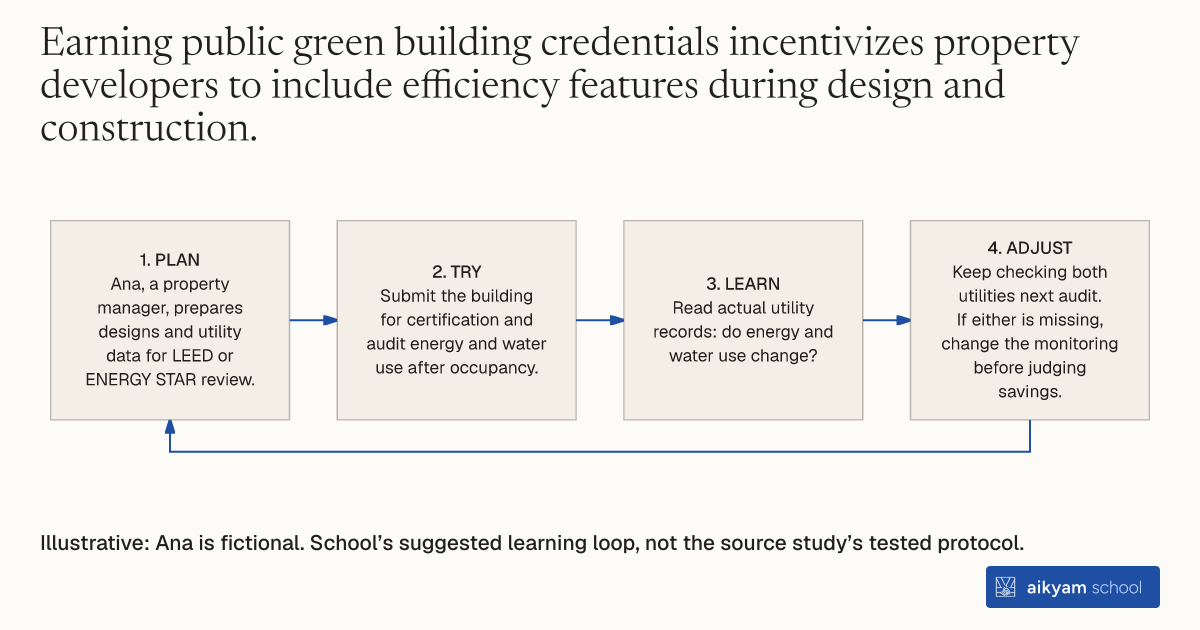
- Plan: Ana, a property manager, prepares designs and utility data for LEED or ENERGY STAR review.
- Try: Submit the building for certification and audit energy and water use after occupancy.
- Learn: Read actual utility records: do energy and water use change?
- Adjust: Keep checking both utilities next audit. If either is missing, change the monitoring before judging savings.
Illustrative: Ana is fictional. School’s suggested learning loop, not the source study’s tested protocol.
See source →School’s suggested, untested learning loop. Observe actual energy and water use; certification alone does not demonstrate savings.
How
When to use
Commercial and public building operations produce substantial greenhouse gas emissions. Property owners and public agencies seek recognized designations to lower building energy consumption and signal environmental leadership. Voluntary certification programs establish design checklists and performance benchmarks to encourage green construction.
Promote voluntary building certifications to benchmark energy performance and incentivize green construction practices.
- Adopt recognized green building certification standards like LEED or ENERGY STAR for commercial and public facilities.
- Direct building developers to incorporate energy-efficient designs and water-saving measures during initial facility planning.
- Submit building design plans and energy consumption data to third-party certification boards for review.
- Display official certification signals on qualifying commercial and federal buildings.
- Audit real-world post-occupancy energy and water usage to ensure certifications achieve actual utility savings.
Why it works
The certifications provide visible market signals that differentiate high-performing commercial properties for prospective tenants.
Example
Federal agencies and commercial building owners across the United States pursued LEED and ENERGY STAR certifications for public and private facilities. Evaluators examined post-certification utility records and found little change in average energy consumption, as ENERGY STAR primarily identified already-efficient buildings while LEED point systems occasionally forced trade-offs between energy and water efficiency.
About the study
Participants
Federal LEED-certified buildings and ENERGY STAR commercial facilities nationwide across the United States.
Study Design
Difference-in-differences evaluations measuring energy usage before and after building certification.
Results
Certified federal LEED buildings and ENERGY STAR commercial buildings showed little to no impact on average building energy use. ENERGY STAR designations frequently signaled existing efficiency rather than motivating new investments, while LEED compliance sometimes forced trade-offs prioritizing energy efficiency over water conservation.