Try, learn and adjust
Check building energy compliance and housing effects
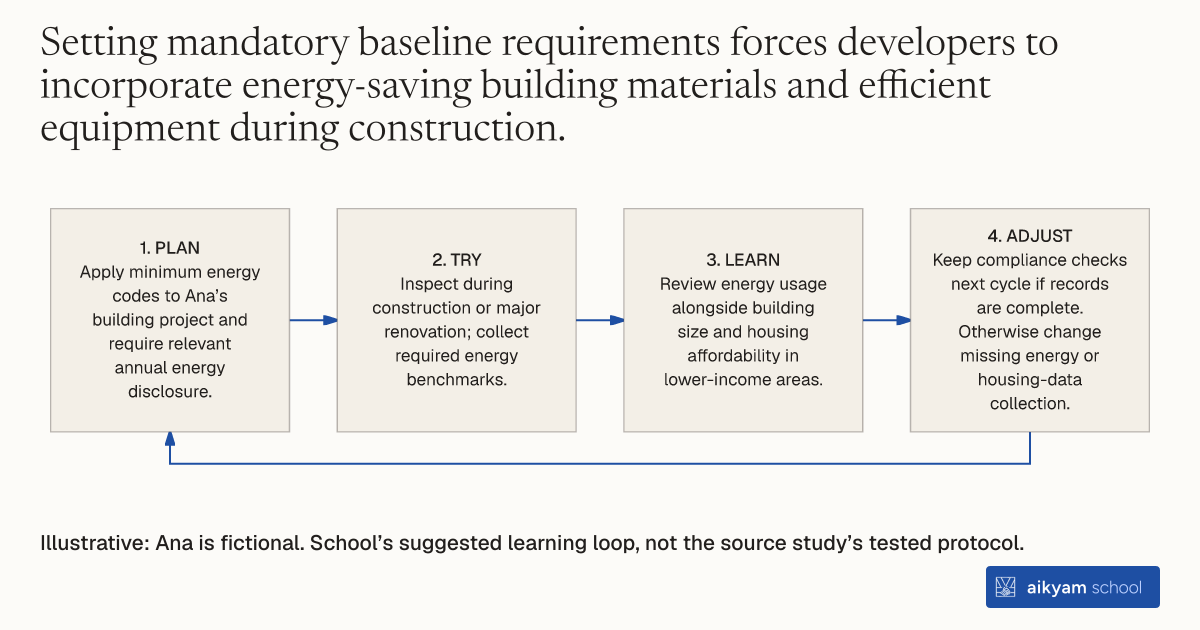
- Plan: Apply minimum energy codes to Ana’s building project and require relevant annual energy disclosure.
- Try: Inspect during construction or major renovation; collect required energy benchmarks.
- Learn: Review energy usage alongside building size and housing affordability in lower-income areas.
- Adjust: Keep compliance checks next cycle if records are complete. Otherwise change missing energy or housing-data collection.
Illustrative: Ana is fictional. School’s suggested learning loop, not the source study’s tested protocol.
See source →School’s suggested learning loop: observe compliance, energy use, unit size and affordability. Reported energy reductions are mixed; this loop does not guarantee savings.
How
When to use
Municipalities face growing building sector greenhouse gas emissions across commercial and residential properties. Property developers and owners often default to baseline construction practices that omit energy efficiency features. Mandatory energy codes and benchmarking programs enforce minimum efficiency thresholds for new construction and building renovations.
Mandate minimum building energy efficiency standards and performance benchmarking for new construction and renovated properties.
- Enact municipal building codes establishing mandatory minimum energy efficiency requirements for residential and commercial structures.
- Require property owners to benchmark and disclose annual energy consumption metrics for renovated and commercial buildings.
- Conduct code compliance inspections during building construction and major renovation permitting processes.
- Monitor regional building energy usage patterns across residential and commercial sectors to track compliance over time.
- Evaluate building size trends and housing affordability impacts in lower-income neighborhoods.
Why it works
Disclosing energy performance metrics encourages property managers to identify and address building energy waste.
Example
Municipalities in California and Florida implemented mandatory building energy codes and benchmarking regulations for new and renovated buildings. Evaluators found mixed results across jurisdictions, with codes contributing to energy reductions in some areas while also causing smaller housing unit sizes in lower-income communities.
About the study
Participants
Commercial and residential property owners, developers, and tenants across California, Florida, Texas, and Sweden.
Study Design
Regression discontinuity, difference-in-differences, and geographic discontinuity designs comparing energy consumption in properties subject to updated building codes against unconstrained control properties.
Results
Building codes setting minimum efficiency thresholds showed mixed energy reduction results, with some research finding little effect beyond broader secular trends toward energy efficiency. In lower-income communities, strict energy codes contributed to reduced total housing unit square footage.