Try, learn and adjust
Check certified buildings against utility records
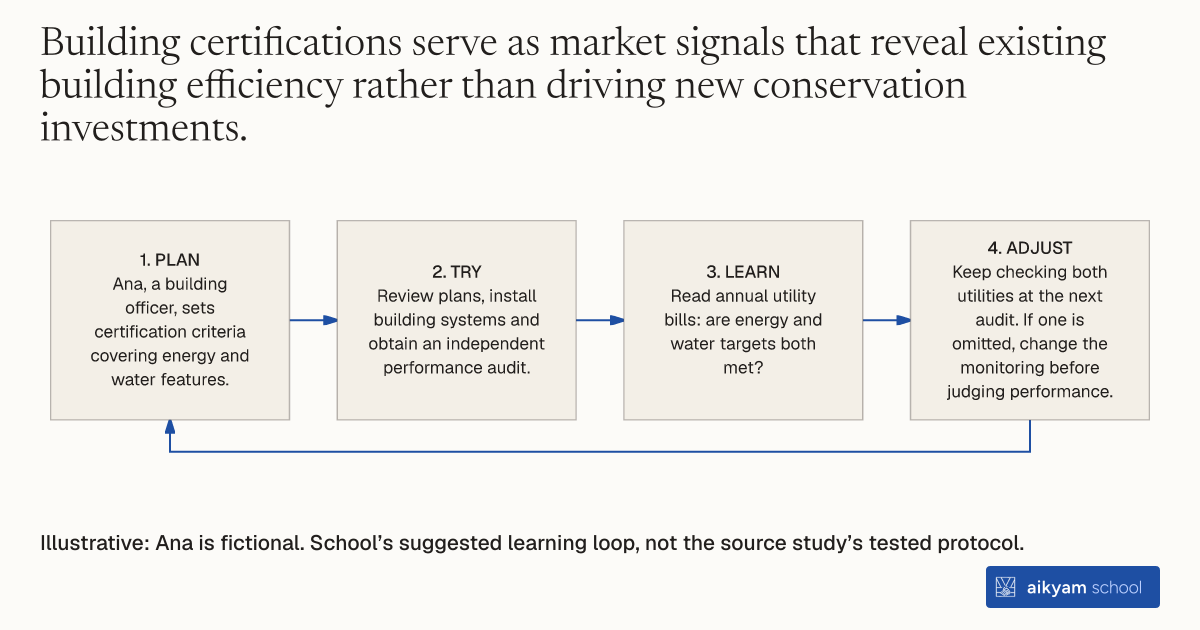
- Plan: Ana, a building officer, sets certification criteria covering energy and water features.
- Try: Review plans, install building systems and obtain an independent performance audit.
- Learn: Read annual utility bills: are energy and water targets both met?
- Adjust: Keep checking both utilities at the next audit. If one is omitted, change the monitoring before judging performance.
Illustrative: Ana is fictional. School’s suggested learning loop, not the source study’s tested protocol.
See source →School’s suggested, untested learning loop. Observe certification compliance and actual energy and water use; average energy savings were not established in the evaluations.
How
When to use
Building energy certification standards like LEED and ENERGY STAR aim to lower commercial and public building energy consumption by encouraging efficiency investments. Property owners seeking certification often focus on easier rating points rather than net energy reductions. Municipalities need to evaluate building certification rules to prevent unexpected trade-offs between energy and water efficiency.
Mandate green building certification standards with independent performance monitoring across public and commercial facilities.
- Municipal building departments establish mandatory certification thresholds such as LEED or ENERGY STAR for targeted real estate developments.
- Property developers submit building design plans incorporating energy and water efficiency features.
- Construction contractors install certified building systems, insulation, and high-efficiency fixtures.
- Independent rating evaluators audit building performance metrics to confirm compliance with certification criteria.
- Program officers track annual post-certification utility billing data to ensure energy reductions match initial targets.
Why it works
Property managers often pursue points in non-energy rating categories like water conservation to achieve certification status.
Example
In retrofitted federal buildings across the United States, evaluating LEED certification showed that building certifications were ineffective at reducing energy consumption on average, because building managers traded off energy efficiency to achieve water efficiency points.
About the study
Participants
Federal buildings and commercial properties across the United States.
Study Design
Quasi-experimental difference-in-differences designs evaluating LEED certification (Clay et al., 2021) and ENERGY STAR commercial buildings (Brolinson et al., 2023).
Results
Building certifications were found to be ineffective at reducing average building energy consumption, with LEED certification driving trade-offs between energy and water savings and ENERGY STAR reflecting pre-existing building efficiency.