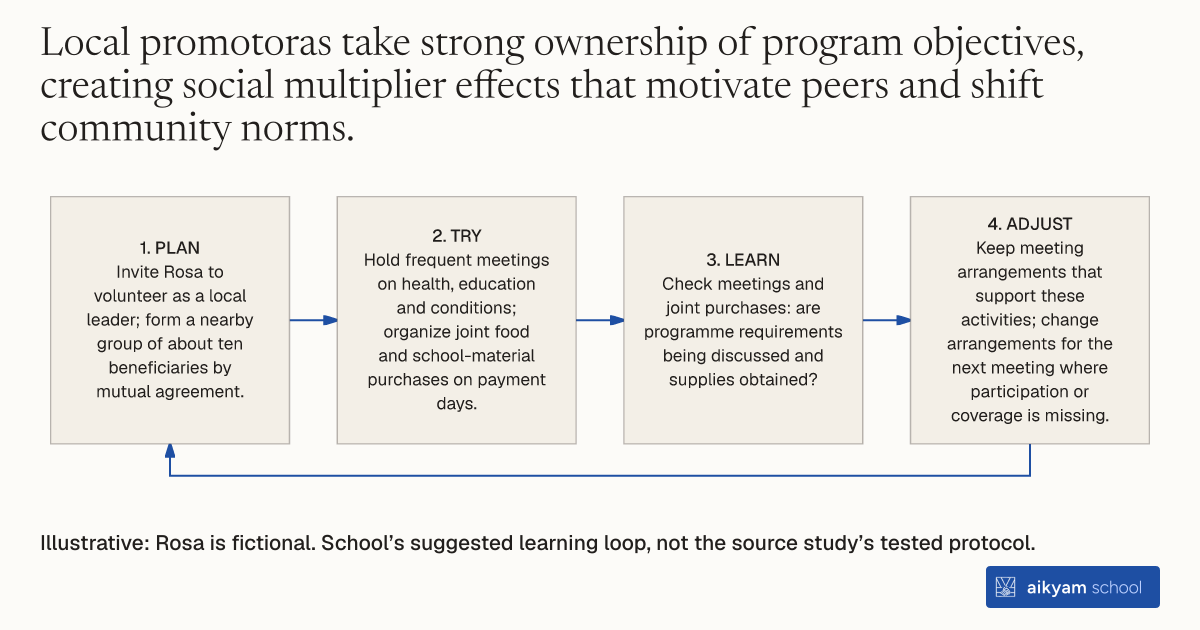
Try, learn and adjust
Check volunteer-led peer meetings
- Plan: Invite Rosa to volunteer as a local leader; form a nearby group of about ten beneficiaries by mutual agreement.
- Try: Hold frequent meetings on health, education and conditions; organize joint food and school-material purchases on payment days.
- Learn: Check meetings and joint purchases: are programme requirements being discussed and supplies obtained?
- Adjust: Keep meeting arrangements that support these activities; change arrangements for the next meeting where participation or coverage is missing.
Illustrative: Rosa is fictional. School’s suggested learning loop, not the source study’s tested protocol.
See source →School’s suggested, untested learning loop. Observe peer meetings, requirements discussed and collective purchases; a volunteer’s example does not establish causal impact.
How
When to use
Poor rural households often lack local role models to encourage long-term human capital investments. Conditional cash transfer interventions can suffer from weak compliance and short-lived impacts once transfers end. Deploy this method among low-income female caregivers in cash transfer interventions to strengthen peer communication and social support.
Establish a network of volunteer female promotoras to lead small local peer groups and reinforce program objectives among beneficiary women.
- Invite beneficiary women during registration assemblies to volunteer as local promotoras for their community.
- Form peer groups of approximately ten beneficiaries living close to each promotora through mutual agreement.
- Conduct frequent group meetings where promotoras discuss health practices, educational goals, and conditionalities with beneficiary women.
- Organize collective purchasing of nutritious food and school materials among peer group members on cash transfer payment days.
- Model high human capital investments and future-oriented behaviors for group members during and after the program.
Why it works
Regular peer interactions expand parents' capacity to aspire by demonstrating tangible gains in child nutrition, health, and schooling.
Example
In 2006, the Ministry of the Family in Nicaragua created promotora leadership positions across 56 treatment communities, where each promotora led a local group of about 10 neighboring women to reinforce program goals.
About the study
Participants
3,000 eligible poor households across 56 treatment communities in 6 municipalities of northwestern Nicaragua, with an average of 4 female leaders per assembly.
Study Design
Two-stage randomized controlled trial where promotoras were randomly assigned across transfer packages, creating exogenous variation in beneficiaries' exposure to successful leaders.
Results
Proximity to leaders receiving the largest package reduced school absences by 0.4 days per month, increased school expenditures by 16 percent, and increased parental expectations for children by 0.27 standard deviations two years post-program.