Research procedure
Model return selection using rainfall
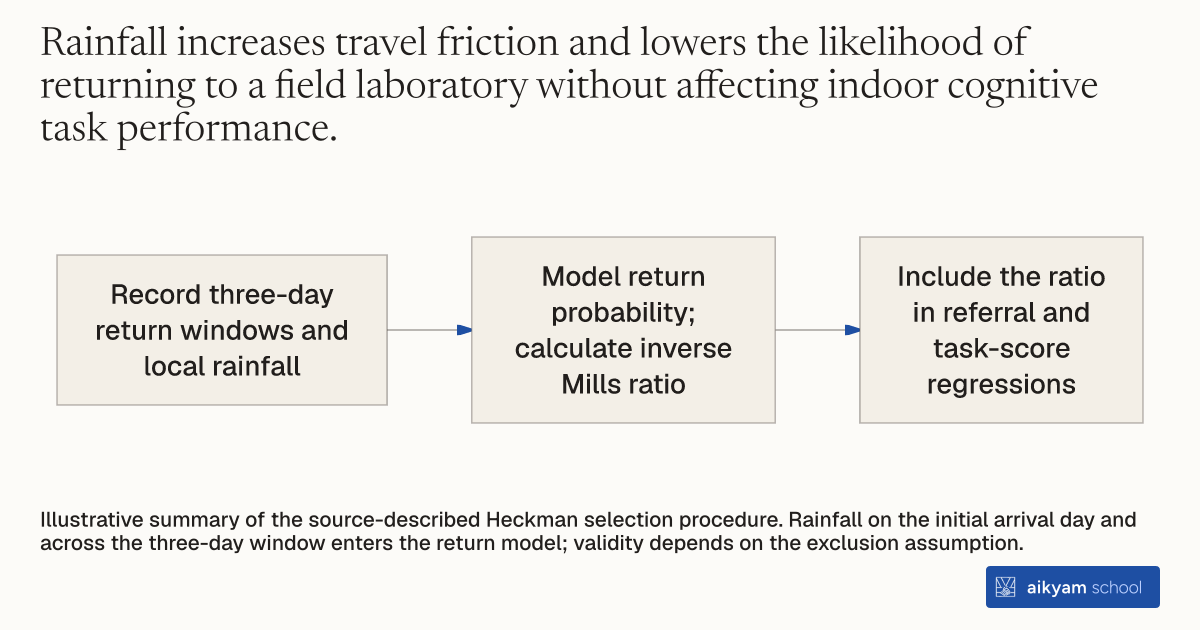
- Record three-day return windows and local rainfall
- Model return probability; calculate inverse Mills ratio
- Include the ratio in referral and task-score regressions
Illustrative summary of the source-described Heckman selection procedure. Rainfall on the initial arrival day and across the three-day window enters the return model; validity depends on the exclusion assumption.
See source →How
When to use
Apply an exogenous weather variable as an exclusion restriction in a two-step selection model when evaluating study participants who choose whether to complete a multi-stage task. Non-random attrition between study stages biases performance estimates if participants who return differ systematically from those who do not. Using localized rainfall variation adjusts for travel reluctance without distorting indoor task performance.
Correct for non-random participant return rates by modeling recruitment-window rainfall as an exclusion restriction in a Heckman selection framework.
- Track the exact three-day appointment window assigned to each participant for returning with a candidate.
- Record daily local rainfall occurrences from weather monitoring stations across each participant's three-day window.
- Record whether rainfall occurred on the initial arrival day of the original participant.
- Estimate a first-stage probit regression predicting return probability using the number of rainy days in the three-day window and arrival day rainfall.
- Calculate the inverse Mills ratio from the first-stage regression for each participant.
- Include the inverse Mills ratio as an explanatory covariate in second-stage regressions estimating candidate referral choices and task scores.
Why it works
This provides a valid exclusion restriction that isolates true candidate screening from participation attrition.
Example
Researchers evaluated 561 male study participants in Kolkata, India, using local daily weather data across three-day recruitment cycles. Each additional day of rainfall during the three-day window reduced participant return rates by 20.7 percentage points.
About the study
Participants
561 male adult labor market participants in Kolkata, India.
Study Design
Heckman two-step selection model using a 0 to 3 day rainfall count exclusion restriction across three-day referral windows.
Results
Rain during the referral cycle reduced return likelihood by 20.7 percentage points per rainy day (p < 0.01), producing a joint chi-squared statistic above 12.6 across cognitive treatment specifications.