Research procedure
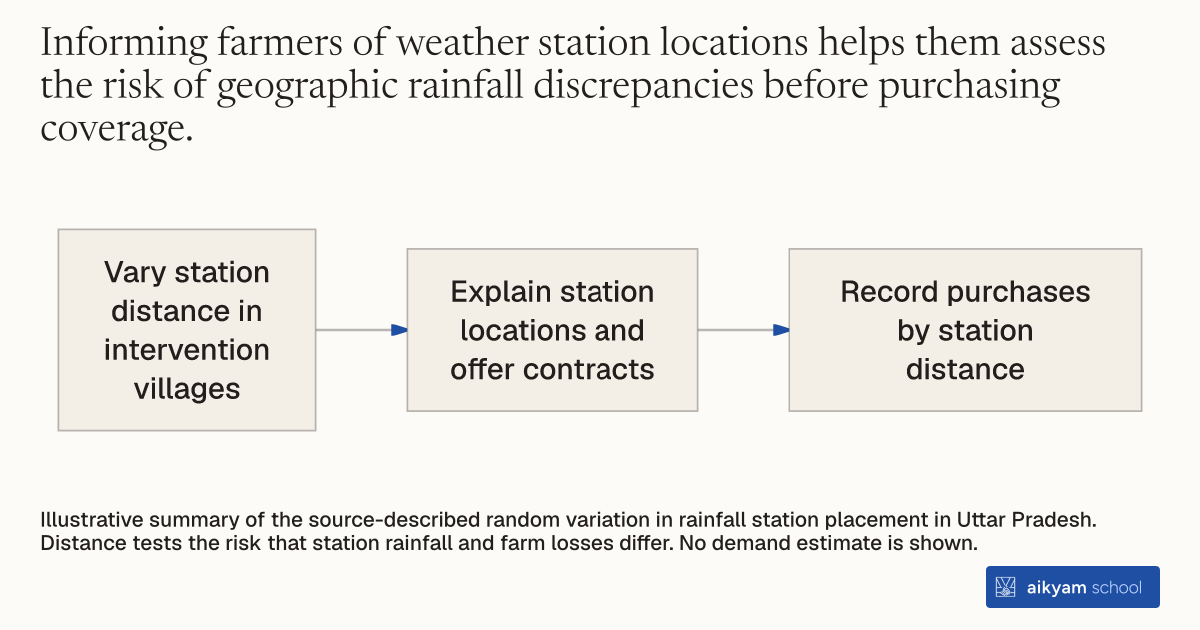
Test distance to rainfall stations
- Vary station distance in intervention villages
- Explain station locations and offer contracts
- Record purchases by station distance
Illustrative summary of the source-described random variation in rainfall station placement in Uttar Pradesh. Distance tests the risk that station rainfall and farm losses differ. No demand estimate is shown.
See source →How
When to use
Index-based weather insurance measures rainfall at centralized weather stations rather than on individual farms. When distance between farms and weather stations increases, insurance payouts may fail to match actual crop losses, creating basis risk that discourages insurance take-up. Systematically varying weather station distances helps program managers measure how basis risk affects demand for formal index contracts among agricultural households.
Randomly vary the distance between weather measurement stations and target agricultural communities during insurance rollout.
- Select rural intervention villages participating in an index-based weather insurance program.
- Position rainfall measurement stations at varying geographic distances from participating agricultural fields.
- Inform household decision-makers of the exact location of their designated weather station during marketing visits.
- Offer index-based monsoon rainfall contracts linked to rainfall levels measured at the designated station.
- Record household insurance purchase decisions across different weather station distance tiers to quantify basis risk sensitivity.
Why it works
Measuring demand changes across distance tiers isolates the specific negative effect of basis risk on voluntary insurance take-up.
Example
Researchers varied rainfall station locations across intervention villages in Uttar Pradesh, India, while marketing monsoon index insurance to 4,677 households. Outreach teams explicitly informed respondents about the location of the nearest weather station. For every additional kilometer of distance between a farmer without informal insurance and the weather station, demand for formal rainfall insurance fell by 6.4 percent.
About the study
Participants
4,677 farming households across 63 villages in Tamil Nadu, Andhra Pradesh, and Uttar Pradesh, India.
Study Design
Randomized controlled trial varying weather station placement across intervention villages in Uttar Pradesh and tracking take-up among 4,677 households receiving direct marketing visits.
Results
For every kilometer increase in distance to the rainfall station for a farmer without informal insurance, demand for formal insurance decreased by 6.4 percent.