Research procedure
Monitor symptoms and risk behaviours
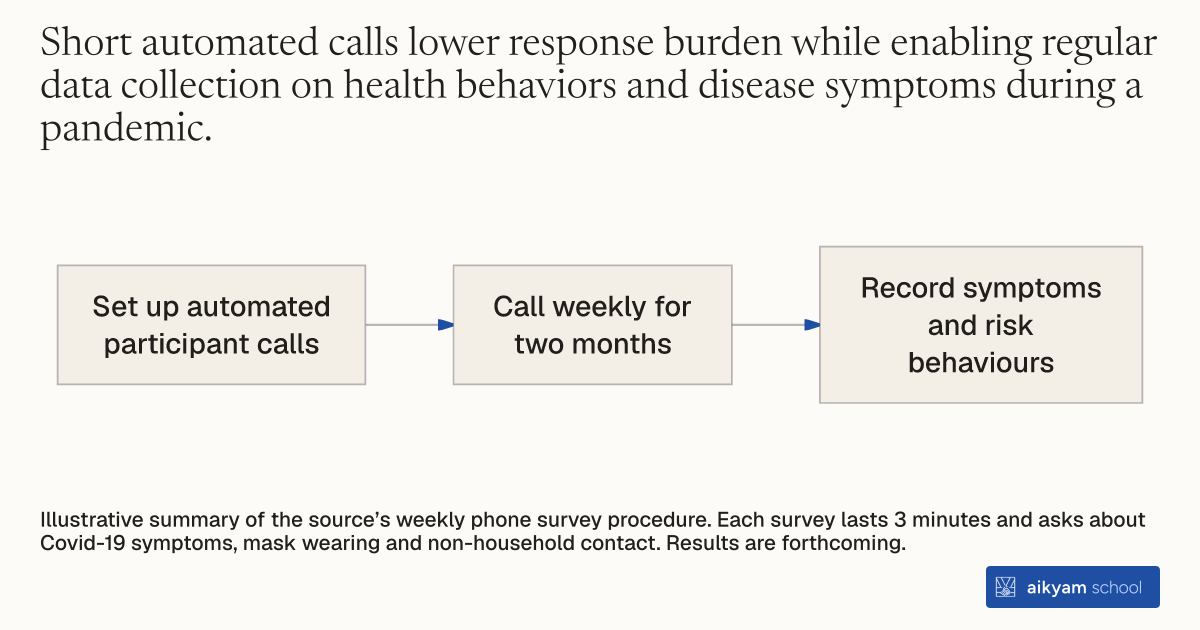
- Set up automated participant calls
- Call weekly for two months
- Record symptoms and risk behaviours
Illustrative summary of the source’s weekly phone survey procedure. Each survey lasts 3 minutes and asks about Covid-19 symptoms, mask wearing and non-household contact. Results are forthcoming.
See source →How
When to use
In an epidemic, tracking ongoing health symptoms and protective health habits across large populations can be difficult. Frequent in-person or lengthy manual phone interviews are costly and cause survey fatigue. Short automated weekly phone calls provide regular longitudinal monitoring for high-risk diabetic and hypertensive adults.
Monitor Covid-19 symptoms and health risk behaviors by delivering short automated weekly phone surveys.
- Set up an automated phone calling system to reach enrolled participants.
- Schedule calls to go out to participants once each week for two months.
- Administer a brief 3-minute survey during each automated call.
- Ask participants about any recent Covid-19 symptoms.
- Record responses regarding risk behaviors like mask wearing and non-household contact.
Example
In Coimbatore, Tamil Nadu, India, researchers sent automated 3-minute phone surveys once a week for two months to 3,680 diabetic and hypertensive adults aged 40 to 70 years old.
About the study
Participants
3,680 diabetic and hypertensive individuals aged 40 to 70 years old in Coimbatore, Tamil Nadu, India.
Study Design
Weekly automated phone survey monitoring over two months in a randomized controlled trial.
Results
Research ongoing; results forthcoming.