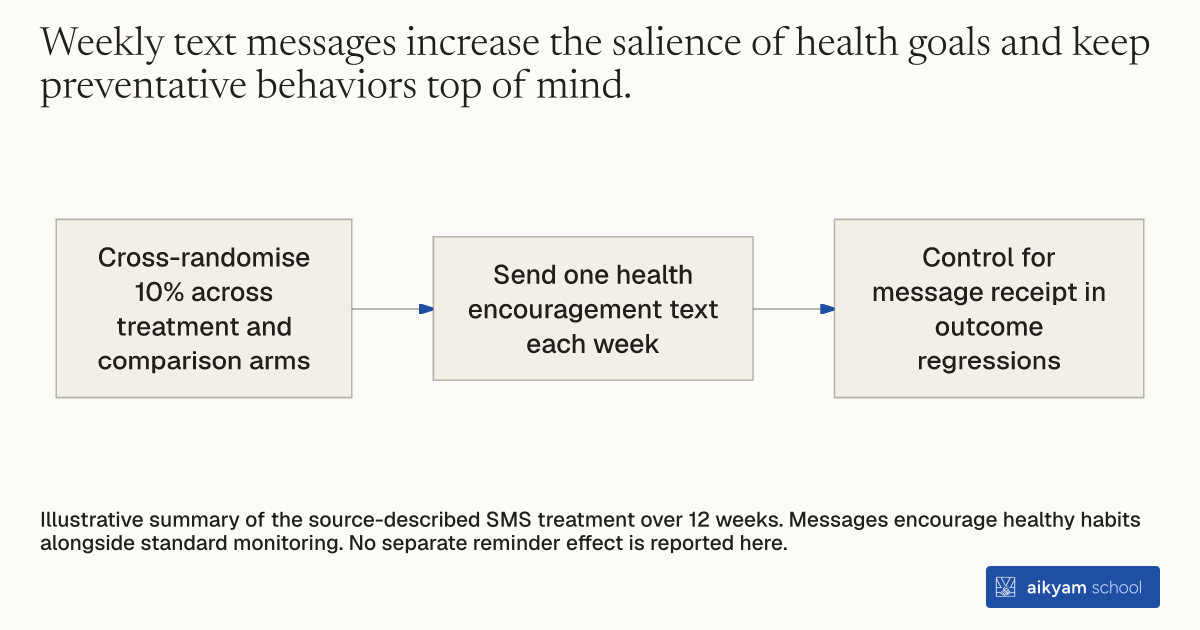
Research steps
Test weekly health reminders
- Cross-randomise 10% across treatment and comparison arms
- Send one health encouragement text each week
- Control for message receipt in outcome regressions
Illustrative summary of the source-described SMS treatment over 12 weeks. Messages encourage healthy habits alongside standard monitoring. No separate reminder effect is reported here.
See source →How
When to use
Health programs want to nudge participants toward regular physical activity and healthy habits without relying solely on financial rewards. People often forget health goals amidst daily routines or lose motivation over long intervention periods. This method serves patients managing chronic health conditions in mobile-connected communities.
Send regular automated text messages containing non-financial health encouragement and behavioral reminders to program participants.
- Draft a series of weekly text messages encouraging participants to engage in healthy habits such as walking and eating well.
- Select a subset of program participants to receive the weekly messaging campaign alongside standard program monitoring.
- Schedule the messaging system to send one text message reminder every week throughout the intervention period.
- Deliver text messages directly to participants' prepaid mobile phone numbers.
- Control for receipt of the weekly reminder messages when evaluating main incentive and health outcomes.
Why it works
Regular nudges provide lightweight encouragement that complements monitoring and financial incentives.
Example
Surveyors cross-randomized 10 percent of trial participants across Coimbatore, India, to receive weekly text message reminders encouraging healthy behaviors. Researchers included receiving the SMS treatment as a control variable across all primary exercise and health regressions.
About the study
Participants
3,192 enrolled participants across Coimbatore, India, with an average age of 49.56 years, 42 percent female, 67 percent diagnosed diabetic, and an average monthly per capita income of 4,465 INR.
Study Design
A randomized evaluation where 10 percent of the sample was cross-randomized across all treatment and comparison arms to receive weekly health encouragement SMS messages over a 12-week program.
Results
Receipt of weekly text message reminders was controlled for across regression specifications evaluating step target compliance, step counts, and blood sugar outcomes.