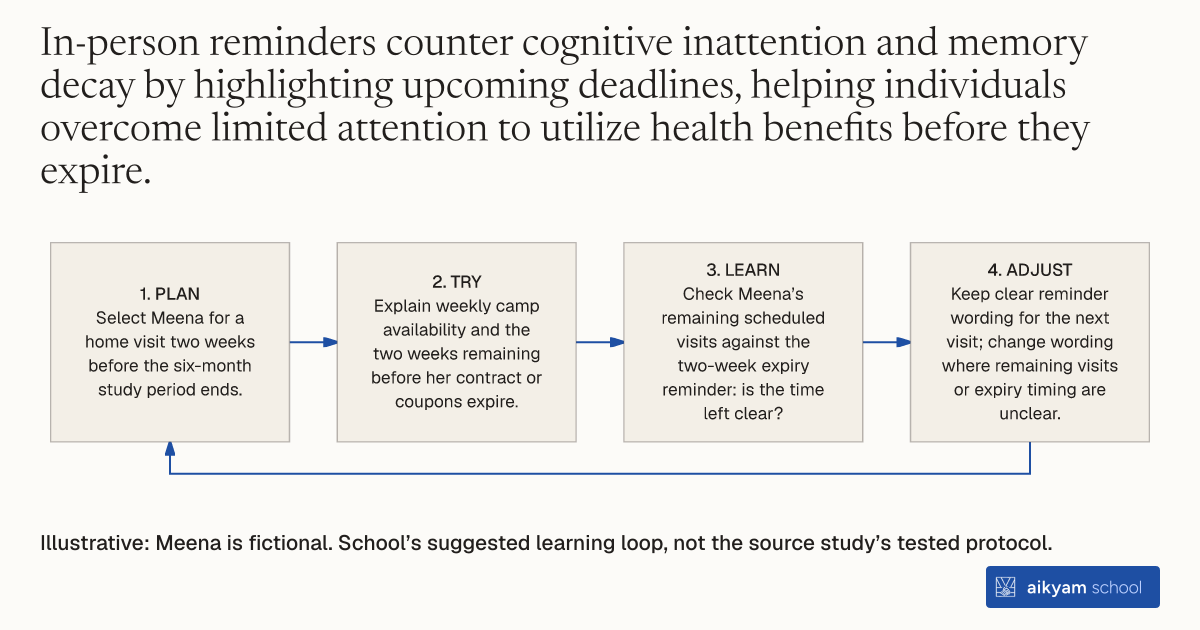
Try, learn and adjust
Check that expiry reminders reach participants
- Plan: Select Meena for a home visit two weeks before the six-month study period ends.
- Try: Explain weekly camp availability and the two weeks remaining before her contract or coupons expire.
- Learn: Check Meena’s remaining scheduled visits against the two-week expiry reminder: is the time left clear?
- Adjust: Keep clear reminder wording for the next visit; change wording where remaining visits or expiry timing are unclear.
Illustrative: Meena is fictional. School’s suggested learning loop, not the source study’s tested protocol.
See source →School’s suggested learning loop, not a tested protocol. Observe remaining scheduled visits and the stated expiry deadline.
How
When to use
Patients may fail to complete preventive care visits or redeem commitment contract benefits due to simple inattention or forgetting upcoming expiration dates. Health providers need an active outreach mechanism to test whether memory nudges improve follow-through. This method conducts in-person door visits shortly before contract or coupon expiration to remind participants of clinic schedules.
Conduct targeted in-person door visits two weeks before program expiration to inform participants of remaining time to complete visits.
- Select target program participants two weeks before the six-month study period ends.
- Assign enumerators to visit participants directly at their homes.
- Enumerators deliver a short verbal reminder regarding weekly health camp availability.
- Enumerators notify participants that exactly two weeks remain before their commitment contracts or discount coupons expire.
- Enumerators encourage participants to complete any remaining scheduled doctor visits before the expiration deadline.
Example
In four rural villages in Punjab, India, enumerators personally visited a randomly selected half of the 1,725 enrolled hypertensive respondents two weeks before six-month contract expiration to remind them of the deadline, but clinic attendance remained unaffected across all treatment arms.
About the study
Participants
Half of 1,725 enrolled hypertensive and high-risk respondents randomly selected across 4 rural villages in Punjab, India (59% female, average age 53.7 years).
Study Design
Cross-randomized RCT trial arm where enumerators delivered in-person household reminder visits 2 weeks prior to 6-month contract/coupon expiration to evaluate inattention.
Results
Post-reminder doctor visits showed no statistically significant difference between the reminder group and control group across all treatment arms, demonstrating that simple inattention did not explain low preventive care attendance.