Try, learn and adjust
Use weekly coaching to address enterprise difficulties
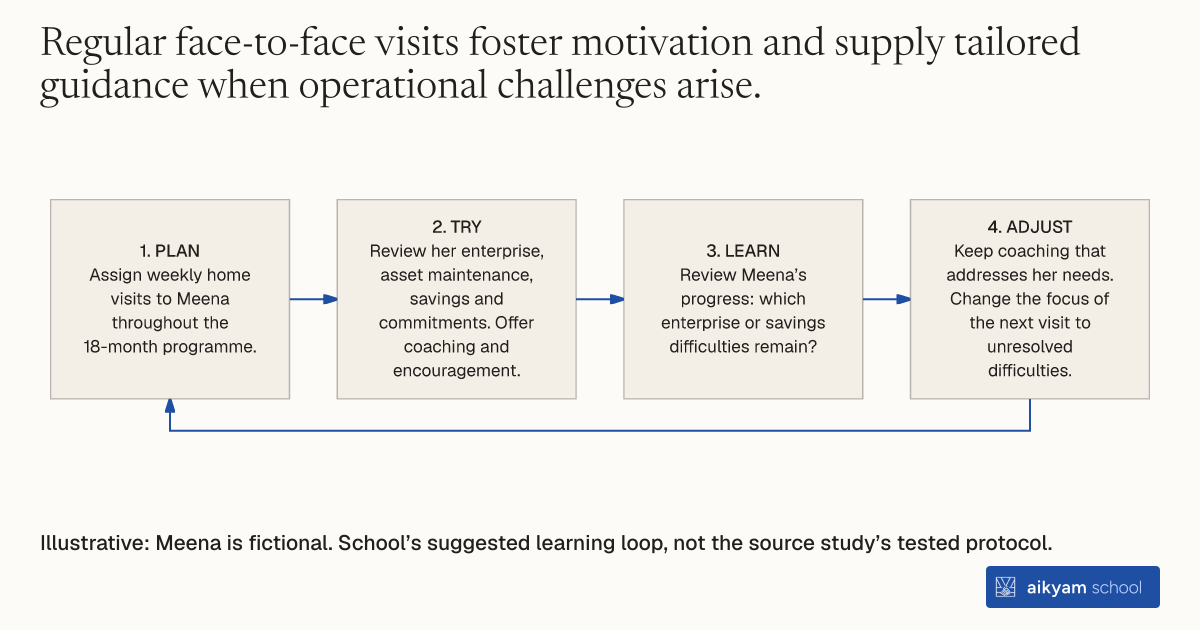
- Plan: Assign weekly home visits to Meena throughout the 18-month programme.
- Try: Review her enterprise, asset maintenance, savings and commitments. Offer coaching and encouragement.
- Learn: Review Meena’s progress: which enterprise or savings difficulties remain?
- Adjust: Keep coaching that addresses her needs. Change the focus of the next visit to unresolved difficulties.
Illustrative: Meena is fictional. School’s suggested learning loop, not the source study’s tested protocol.
See source →School’s suggested, untested loop. Observe enterprise operation, asset care and savings progress; this does not isolate coaching effects.
How
When to use
Extremely poor rural households face severe isolation and low confidence, making enterprise management difficult. Ultra-poor families adopting new productive assets need ongoing support to overcome daily hurdles and build discipline. Program teams use this method to provide continuous personal mentorship, accountability, and practical guidance.
Conduct regular weekly household visits to provide continuous coaching, encouragement, and accountability to ultra-poor participants.
- Assign organization staff to visit each participating household's home every week over an 18-month program period.
- Review microenterprise operations and check productive asset maintenance during each visit.
- Provide direct operational coaching to help household members resolve enterprise challenges.
- Offer personal encouragement to reinforce household confidence and long-term planning.
- Track participant progress on savings obligations and program commitments.
Why it works
Continuous encouragement helps vulnerable households maintain financial discipline and remain committed to building sustainable livelihoods.
Example
In West Bengal, India, Bandhan staff conducted weekly home visits for 514 ultra-poor program participants over 18 months. Supported by regular coaching, adults in participant households spent 21 minutes more per day on productive activities one year after program completion compared to the comparison group average of 3 hours 45 minutes.
About the study
Participants
978 ultra-poor households in Murshidabad, West Bengal, India, consuming 40 US dollars per month on average.
Study Design
Randomized controlled trial comparing 514 treatment households receiving the 18-month Graduation package against 464 comparison households over ten years.
Results
Adults in participating households increased daily productive time by 21 minutes over the comparison group baseline of 3 hours 45 minutes, while measures of mental and physical health improved over ten years.