Research procedure
Survey neighbours for within-village spillovers
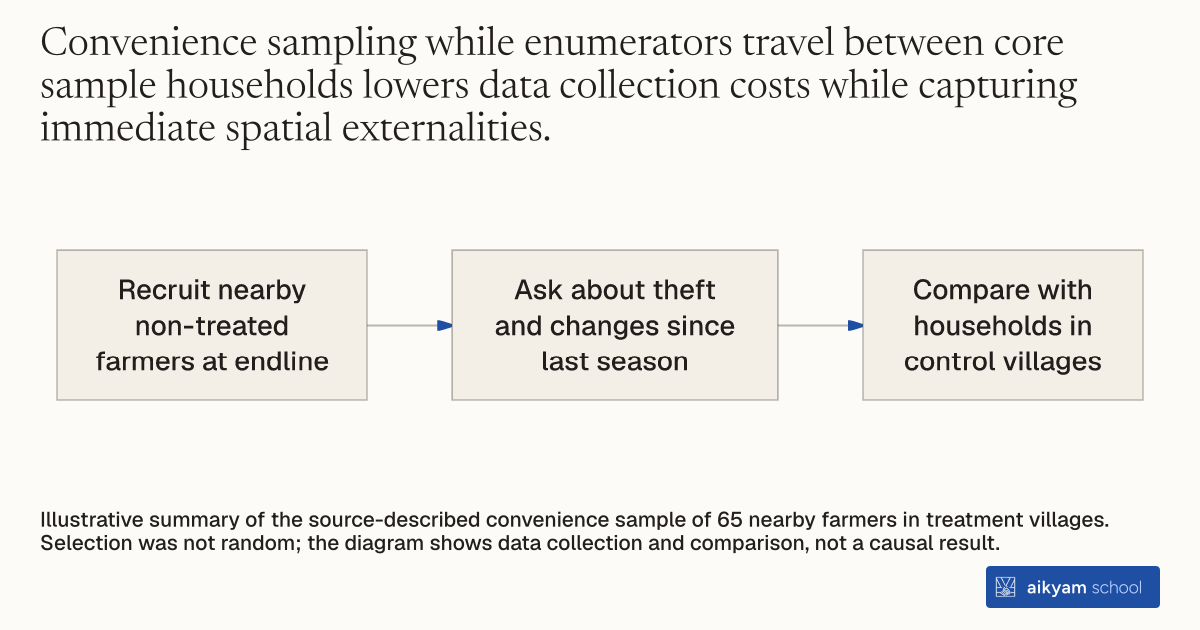
- Recruit nearby non-treated farmers at endline
- Ask about theft and changes since last season
- Compare with households in control villages
Illustrative summary of the source-described convenience sample of 65 nearby farmers in treatment villages. Selection was not random; the diagram shows data collection and comparison, not a causal result.
See source →How
When to use
Evaluating localized security interventions requires testing whether guard protection creates positive security spillovers for non-guarded neighbors. Formal random sampling across every nearby plot can be logistically unfeasible during rapid post-harvest household visits. This method recruits a convenience sample of nearby villagers to capture within-village crime deterrence.
Sample nearby non-treated farming households within treatment villages to evaluate localized security spillovers.
- Direct survey enumerators to identify non-treated farming households located near treated farms while traveling through treatment villages.
- Recruit a convenience sample of nearby farmers during endline survey collection visits.
- Administer endline survey modules measuring crop theft experienced during the intervention season.
- Record respondent perceptions regarding whether local crop theft increased, stayed the same, or decreased relative to the prior season.
- Compare crime outcomes between spillover households in treatment villages and non-treated households in control villages.
Why it works
The visible presence of watchmen on nearby plots deters opportunistic thieves across surrounding non-guarded farms.
Example
Researchers surveyed a convenience sample of 65 nearby farmers across treatment villages in Migori County, Kenya at endline. Non-guarded neighbors in treatment villages reported a 26.4 percentage point drop in crop theft occurrence and a 35.4 percentage point increase in reporting reduced theft relative to the prior season.
About the study
Participants
65 non-treated nearby farmers within treatment villages in Migori County, Kenya.
Study Design
Convenience sampling of non-treated neighboring households within treatment villages during endline data collection, evaluated using regression analysis against control households.
Results
Spillover farmers in treatment villages were 26.4 percentage points less likely to experience crop theft during the treatment season (p < 0.01) and 35.4 percentage points more likely to report that crop theft decreased relative to the previous season (p < 0.05).