Research procedure
Compare targeting policies
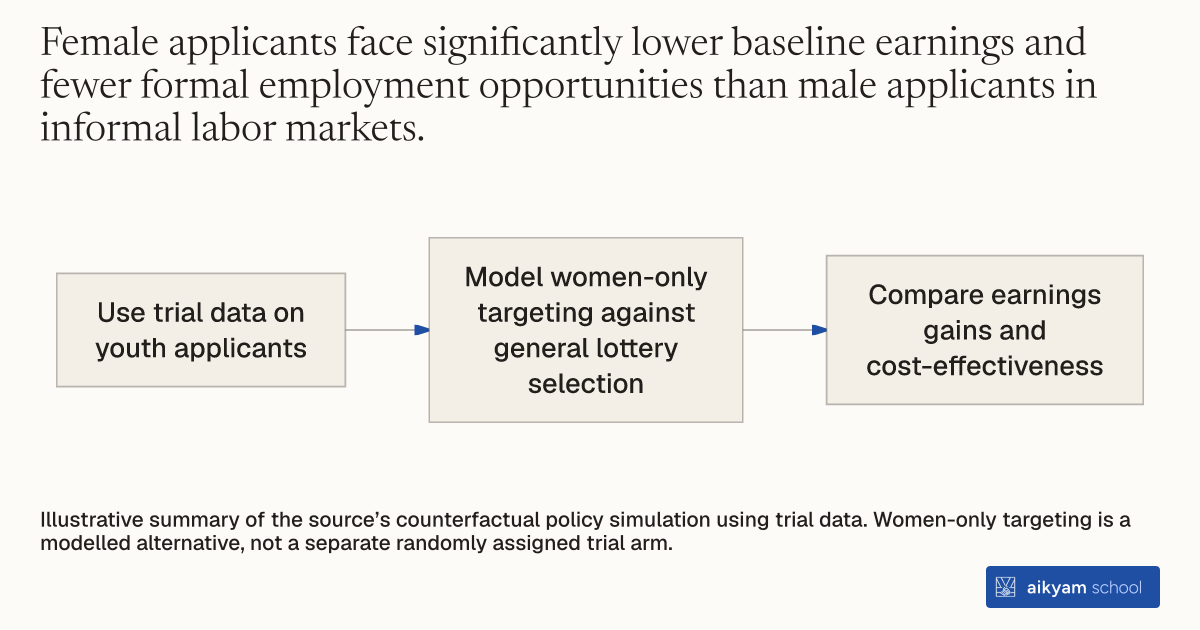
- Use trial data on youth applicants
- Model women-only targeting against general lottery selection
- Compare earnings gains and cost-effectiveness
Illustrative summary of the source’s counterfactual policy simulation using trial data. Women-only targeting is a modelled alternative, not a separate randomly assigned trial arm.
See source →How
When to use
Public works programs using minimum-wage self-targeting attract many male applicants with outside informal income opportunities, diluting net economic gains. Targeting women exclusively channels temporary employment to a vulnerable demographic facing worse baseline informal opportunities. This method serves young urban women in developing countries with high underemployment and gender wage gaps.
Restrict public works enrollment exclusively to female applicants to maximize program earnings gains and cost-effectiveness.
- Announce public works enrollment with eligibility restricted exclusively to young women residing in target urban localities.
- Register female applicants and record baseline demographic, asset, and earnings details.
- Allocate available public works employment slots among registered female applicants using public lotteries or direct selection.
- Open formal individual bank accounts for enrolled female participants for direct monthly wage transfers.
- Assign female beneficiaries to structured public works brigades remunerated at the daily formal minimum wage.
Why it works
Restricting program entry to women isolates inframarginal workers who experience smaller foregone earnings when accepting workfare jobs.
Example
In Côte d'Ivoire, machine learning counterfactual analysis evaluated restricting public works targeting exclusively to female applicants among 2,912 urban youth. Targeting women generated average monthly contemporaneous earnings gains of 32,097 CFA francs per participant compared to 27,083 CFA francs under general lottery selection, representing a 19 percent increase in short-term earnings impact. Post-program monthly earnings gains reached 7,168 CFA francs, improving the program cost-benefit ratio from 3.03 to 2.33.
About the study
Participants
2,912 urban youth applicants aged 18 to 30 years across 16 localities in Côte d'Ivoire (43% female in baseline sample).
Study Design
Randomized controlled trial evaluating workfare beneficiaries, combined with machine learning (Generalized Random Forest) counterfactual policy simulation comparing women-only targeting against general lottery selection.
Results
Targeting women increased during-program monthly earnings gains by 19 percent from 27,083 CFA francs under general lottery selection to 32,097 CFA francs (with 55 percent of the top treatment-impact quartile being female compared to 13 percent in the bottom quartile). Post-program monthly earnings gains reached 7,168 CFA francs, reducing the program cost-benefit ratio from 3.03 down to 2.33, achieving a 23 percent improvement in cost-effectiveness.