Research design
Allocate work through gender-specific lotteries
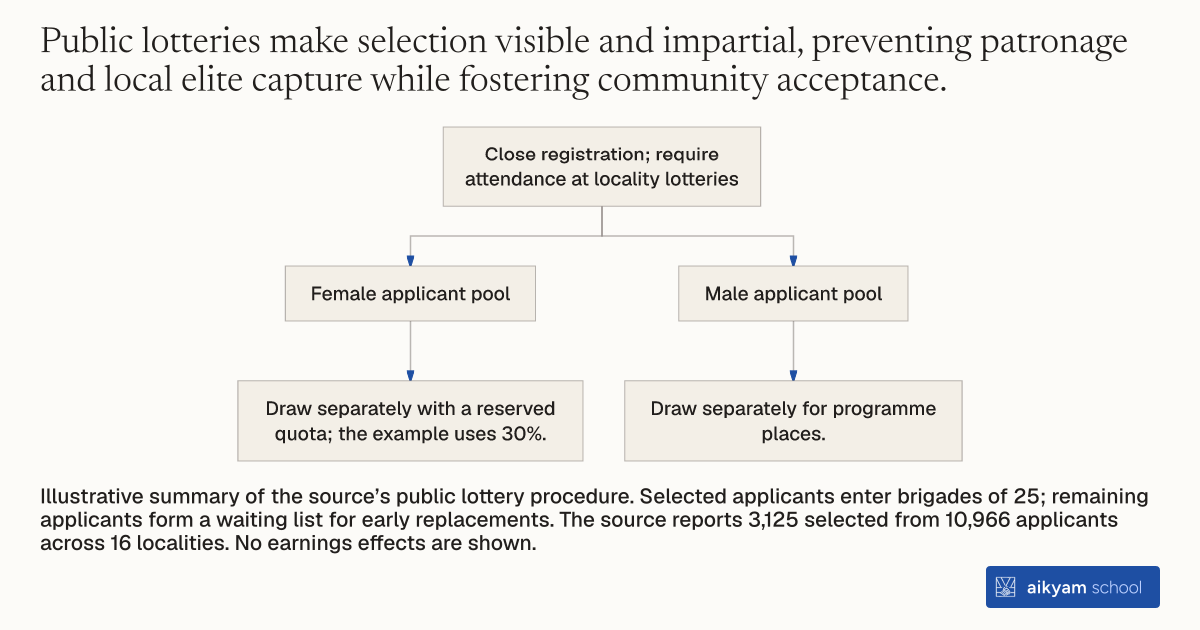
Close registration; require attendance at locality lotteries
- Female applicant pool
- Draw separately with a reserved quota; the example uses 30%.
- Male applicant pool
- Draw separately for programme places.
Illustrative summary of the source’s public lottery procedure. Selected applicants enter brigades of 25; remaining applicants form a waiting list for early replacements. The source reports 3,125 selected from 10,966 applicants across 16 localities. No earnings effects are shown.
See source →How
When to use
In low-income settings with widespread youth underemployment, public works employment opportunities are heavily oversubscribed, creating risks of patronage, corruption, or local tension during selection. Transparent selection methods ensure fair access and community trust when allocating limited public employment slots. Assigning program slots through public lotteries with reserved female quotas guarantees transparent distribution and female inclusion.
Allocate oversubscribed public works employment slots using public lotteries conducted separately by gender in target communities.
- Organize an open registration campaign across participating municipalities with basic age eligibility criteria.
- Reserve a pre-determined quota of program slots (such as 30%) specifically for female applicants.
- Establish public lottery events in each locality and mandate physical attendance for registered applicants.
- Conduct public draws separately for male and female applicant pools to randomly select beneficiaries and assign them to work brigades of 25 individuals.
- Create a transparent waiting list from remaining unselected lottery participants to replace early dropouts.
Why it works
Gender-stratified lotteries ensure that female applicants achieve guaranteed representation in public works without competing directly against male applicant numbers.
Example
In Côte d'Ivoire, the PEJEDEC project used public lotteries in 16 urban localities to select 3,125 public works beneficiaries from 10,966 applicants for wave two. A 30% quota was reserved for women, resulting in brigades composed of 17 men and 8 women. The transparent public drawing process generated widespread social acceptance and provided the basis for a randomized controlled trial.
About the study
Participants
10,966 youth applicants aged 18 to 30 years across 16 urban localities in Côte d'Ivoire, of whom 3,125 were selected into 125 public works brigades.
Study Design
Randomized controlled trial leveraging the oversubscription and public lottery selection process across 16 urban municipalities, with separate lotteries run for male and female applicants.
Results
The lottery process successfully selected 3,125 beneficiaries (43% female) with baseline characteristics similar to non-selected applicants. Machine learning heterogeneity analysis subsequently showed that women selected via the lottery achieved 19% higher contemporaneous earnings gains (CFA 32,097) compared to average lottery selection (CFA 27,083), making female targeting an effective adjustment to traditional self-targeting.