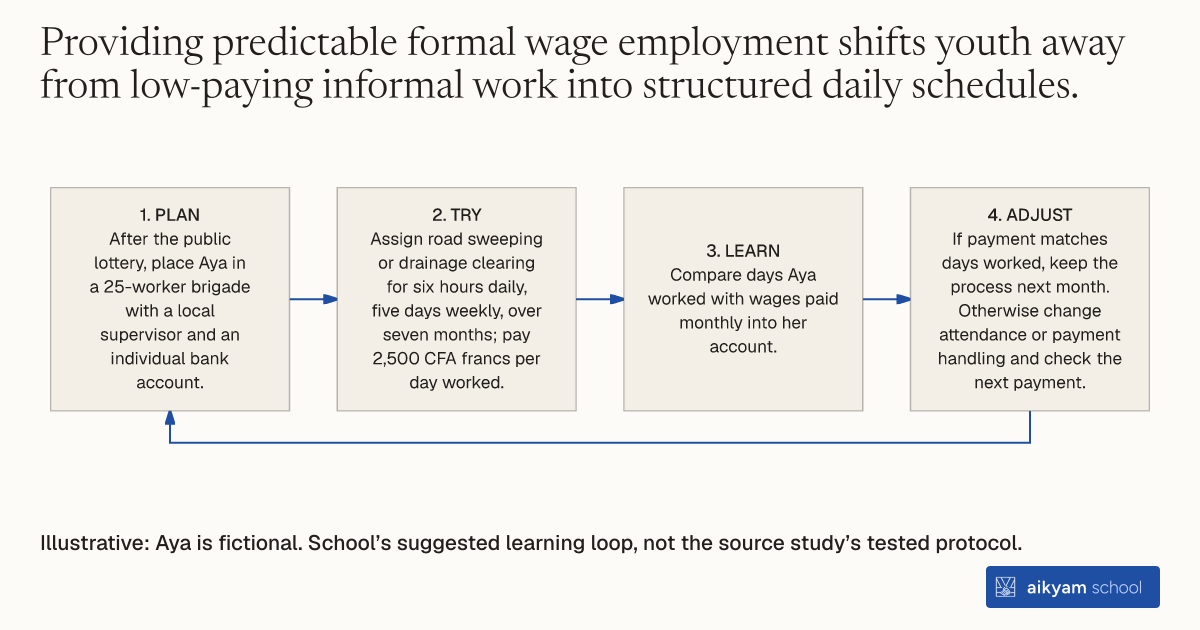
Try, learn and adjust
Check public works attendance and wage payment
- Plan: After the public lottery, place Aya in a 25-worker brigade with a local supervisor and an individual bank account.
- Try: Assign road sweeping or drainage clearing for six hours daily, five days weekly, over seven months; pay 2,500 CFA francs per day worked.
- Learn: Compare days Aya worked with wages paid monthly into her account.
- Adjust: If payment matches days worked, keep the process next month. Otherwise change attendance or payment handling and check the next payment.
Illustrative: Aya is fictional. School’s suggested learning loop, not the source study’s tested protocol.
See source →Observe days worked and wages paid. The source reports no lasting effect on total employment or earnings after the programme. School’s suggested learning loop; not a tested source procedure.
How
When to use
Urban areas in low-income countries face widespread youth underemployment in low-paying informal activities. Temporary public works provide income support and structured work experience for low-skilled young men and women. The program offers temporary road maintenance jobs remunerated at the statutory minimum wage to help youth build savings and work habits.
Deploy a structured public works program offering temporary employment in road maintenance to urban youth.
- Register eligible young adults aged 18 to 30 years residing in target urban municipalities.
- Select participants through public lotteries and organize them into brigades of 25 workers under local supervisors.
- Open formal bank accounts for each participant to receive direct monthly wage payments.
- Assign participants road maintenance tasks such as sweeping streets and clearing drainage ditches for six hours per day, five days per week, over seven months.
- Pay workers the statutory daily minimum wage of 2,500 CFA francs per day worked.
Why it works
The regular income allows participants to accumulate savings and purchase basic necessities while acquiring work habits.
Example
The government of Côte d'Ivoire offered seven months of public works employment to 3,125 urban youth across 16 localities. Participants worked 141 days on average out of 154 available work days and earned a daily wage of 2,500 CFA francs. Monthly earnings rose by 27,083 CFA francs during participation, while average savings stock increased by 39,786 CFA francs.
About the study
Participants
4,160 urban youth aged 18 to 30 years across 16 localities in Côte d'Ivoire, with 43% women and 49% having not completed primary school.
Study Design
Randomized controlled trial comparing 3,125 program beneficiaries selected via public lotteries against a control group of 1,035 non-selected applicants, evaluated at baseline, midline (4 to 5 months in), and endline (12 to 15 months post-program).
Results
Monthly earnings increased by 27,083 CFA francs during the program from a control baseline of 42,841 CFA francs, wage employment increased by 48 percentage points, and savings stocks rose by 39,786 CFA francs at midline. Post-program impacts showed a sustained savings stock increase of 11,505 CFA francs and a well-being index increase of 0.11 standard deviations, but no lasting impacts on total employment or earnings.